Insights & Updates
Latest from Tattle
Discover trends, tips, and insights to elevate your restaurant operations.
Discover trends, tips, and insights to elevate your restaurant operations.
 The Tattle Team
Going into 2026, the math of running a restaurant has quietly flipped. Traffic is harder to win, ad costs keep climbing, and the diners you already have are getting easier to lose. Nearly half of diners say their favorite chain changed in the past year — up sharply from a year earlier — and roughly half of operators now name bringing back repeat customers as one of their biggest challenges.
That makes restaurant customer retention the single highest-leverage thing most multi-unit brands can work on this year. The brands pulling ahead aren't necessarily spending more on acquisition. They're plugging the leaks in the experience, recovering guests before they walk, and turning one good visit into a habit.
This playbook lays out the why and the how: the economics that make retention worth prioritizing, the metrics that actually predict whether a guest comes back, and seven concrete plays you can run across your locations.
In this guide
- What restaurant customer retention is, and how to calculate it
- Why a small retention gain produces an outsized profit lift
- The 2026 benchmarks every operator should know
- Seven repeatable retention plays — from quick wins to system change
- The metrics to put on your dashboard
- How leading multi-unit brands operationalize all of it
Restaurant customer retention is the practice of getting guests to come back, instead of relying on a constant stream of new ones. It measures how well your brand turns a first visit into a second, a second into a tenth, and an occasional diner into a regular.
It matters because repeat customers are where the money is: 65–80% of restaurant sales come from returning guests, and existing guests tend to spend meaningfully more per order than first-timers. Retention is not a loyalty-program line item — it's the outcome of every operational and experience decision you make.
Use this formula for any period (a month, a quarter, a year):
Retention Rate = ((E − N) ÷ S) × 100
- S = guests at the start of the period
- E = guests at the end of the period
- N = new guests acquired during the period
Worked example: You start the quarter with 1,000 identifiable guests, finish with 1,100, and acquired 300 new ones along the way. Your retention rate is ((1,100 − 300) ÷ 1,000) × 100 = 80%. The closer that number gets to 100%, the less you depend on costly acquisition to hold revenue steady.
The economics of keeping a guest have been studied for decades, and the conclusion is consistent across industries: small improvements in retention compound into large gains in profit.
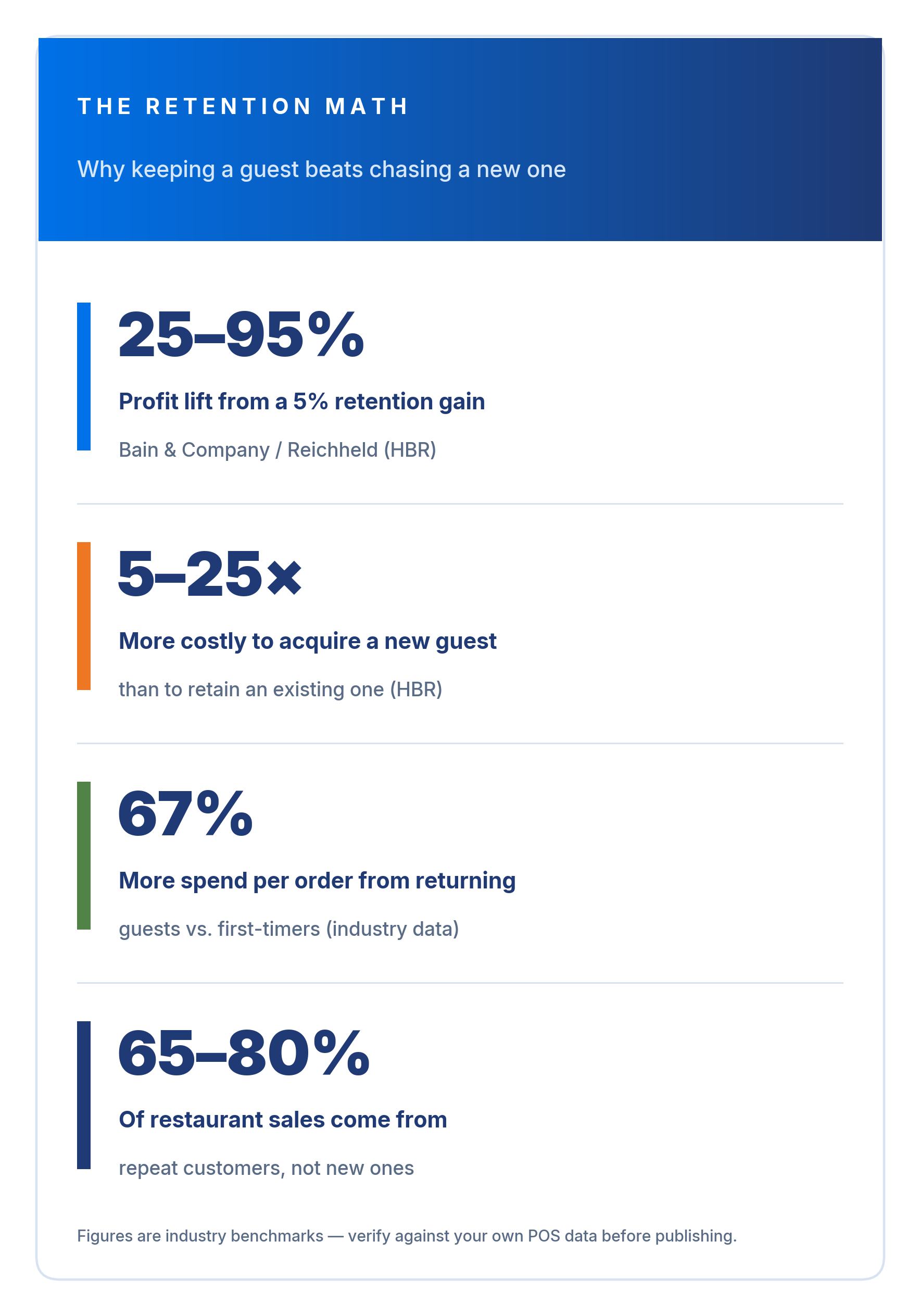
The classic finding — from Frederick Reichheld at Bain & Company, popularized by Harvard Business Review — is that increasing customer retention by just 5% can raise profits by 25% to 95%. The mechanism is intuitive: returning guests cost less to serve, spend more over time, and refer others. Meanwhile, acquiring a new customer runs an estimated 5–25× the cost of keeping an existing one.
For restaurants specifically, the picture going into 2026 is a clear opportunity:
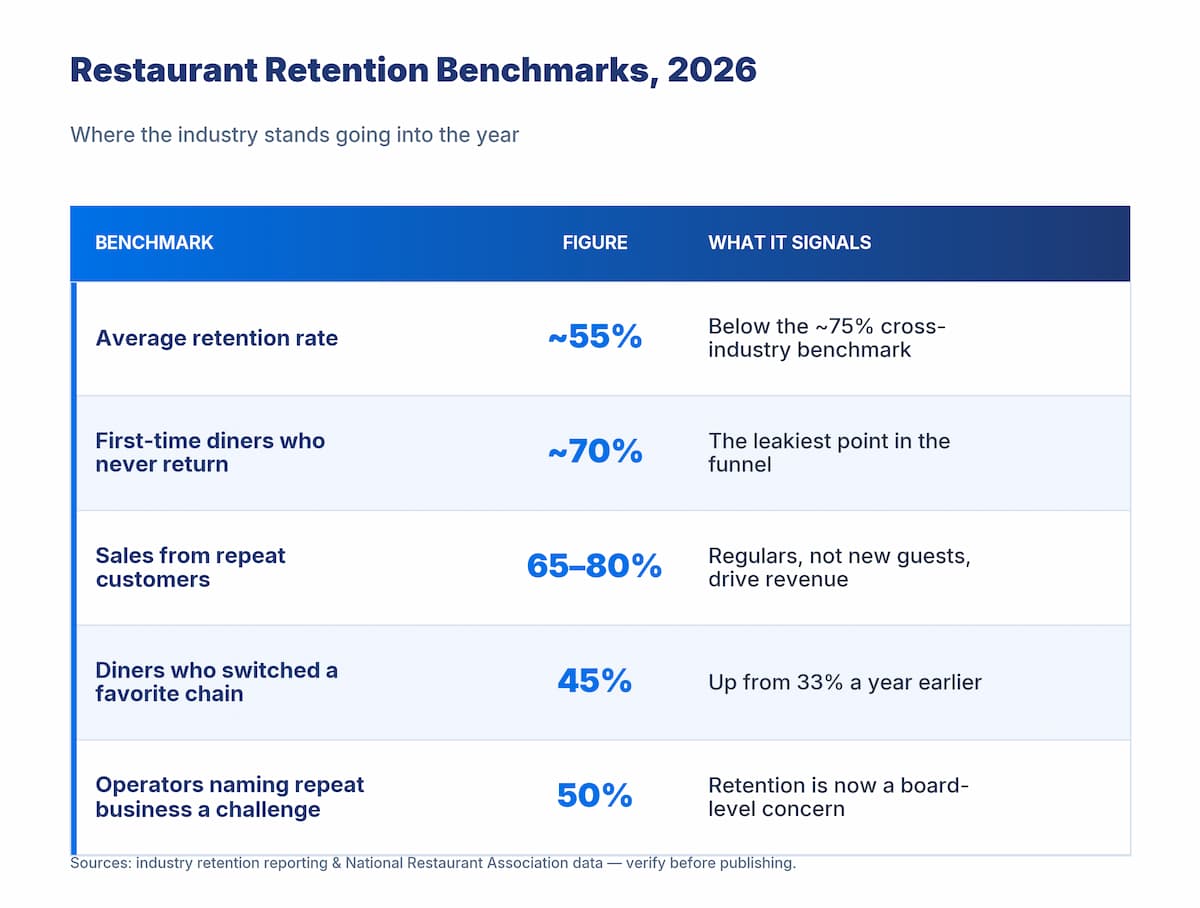
The gap between the ~55% average restaurant retention rate and the ~75% benchmark seen across industries is the headline. About 70% of first-time diners never come back — which means most acquisition spend is leaking straight out the bottom of the funnel. Closing even part of that gap is cheaper, faster, and more durable than buying your way to the same revenue with new guests.
💡 The reframe: Don't think of retention as a marketing tactic. Think of it as the return on every dollar you already spent acquiring the guests you have.
Retention isn't one move, it's a system. Below are seven plays, ordered roughly from quick wins to deeper operational change. Run them together and they reinforce each other.
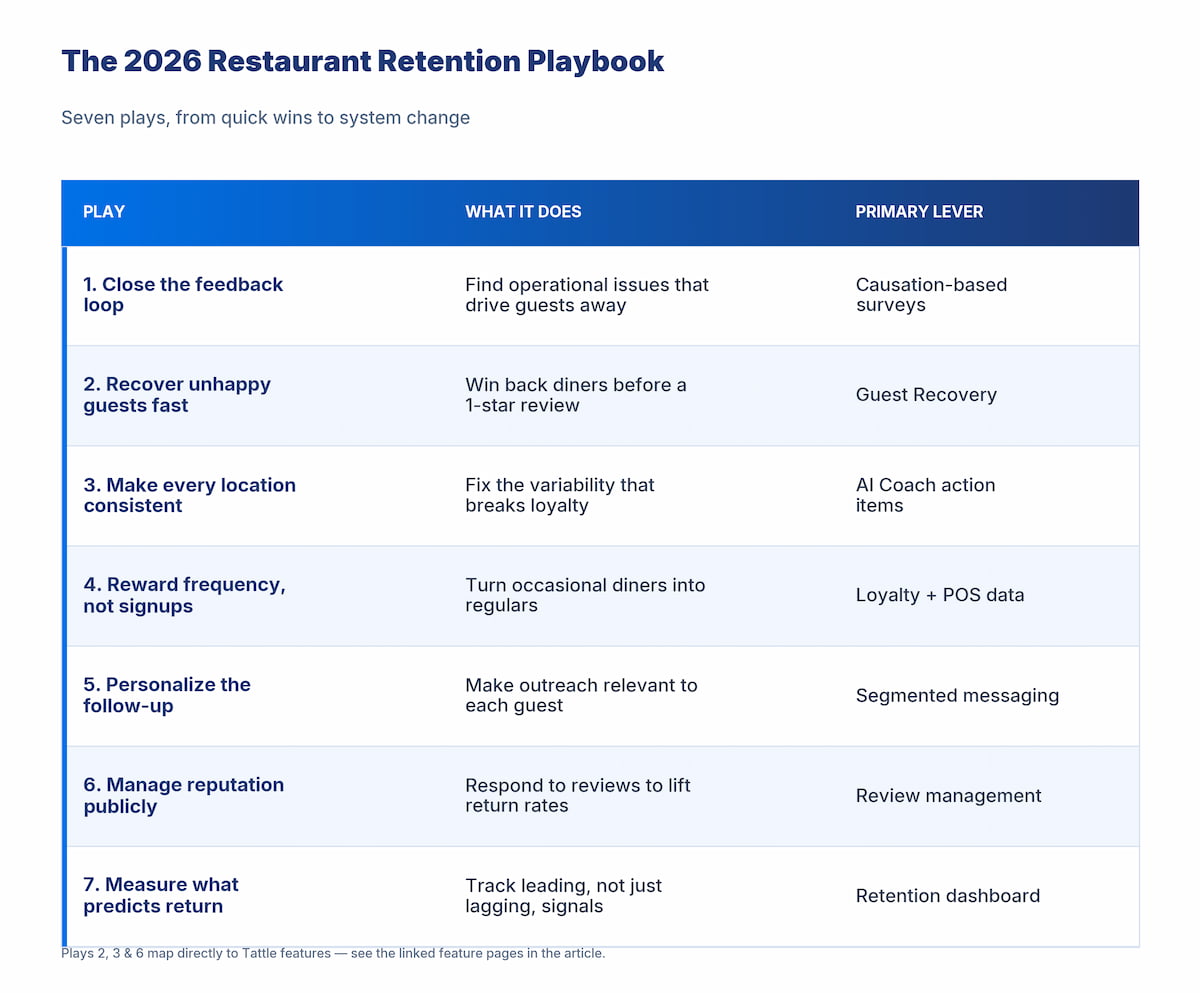
Most churn is silent. A guest has a mediocre visit, says nothing, and simply doesn't return. The fix is to capture feedback at the moment of the transaction and route it to the people who can act on it. The highest-value programs go beyond a star rating and use causation-based surveys that connect satisfaction to specific operational drivers — food temperature, speed, accuracy, hospitality — so you're fixing root causes, not symptoms.
A single unresolved bad experience is a lost regular — and increasingly, a public 1-star review. But recovery works: industry data suggests a majority of unhappy customers will return if their issue is resolved quickly. The operational requirement is speed and accountability — someone has to see the negative feedback in near-real-time and reply before the guest's frustration hardens.
This is exactly the workflow Tattle's Guest Recovery is built for: surfacing at-risk guests instantly, drafting AI-assisted replies, and tracking win-backs, reply rate, time-to-respond, and recovered revenue in one place.
For multi-unit brands, the biggest retention killer is variability. A guest's loyalty is built at their location — and one off night at one store breaks it. Consistency is an operations problem: every general manager needs to know the specific thing to fix at their store this week, in language tied to your brand standards.
This is where Tattle's AI Coach fits — it turns each location's feedback into a short, prioritized list of action items aligned to your SOPs, so improvement happens store-by-store instead of in a quarterly all-hands.
A loyalty program only drives retention if it changes behavior. The data is consistent: loyalty members visit and spend roughly 20% more than non-members. But signups are a vanity metric — design the program around visit frequency and the next visit, not one-time enrollment perks, and connect it to your POS so rewards reflect real behavior.
Generic blasts get ignored. A message that references a guest's last visit, channel, or favorite item earns the open and the return trip. You don't need a data-science team — you need clean guest data and segmentation by recency, frequency, and sentiment. The goal is relevance, not volume.
Reviews are both a retention signal and a retention lever. Responding to reviews is associated with materially higher return rates, and prospective guests read your replies as a proxy for how you'll treat them. Pulling public reviews and private survey feedback into one view lets you respond faster and spot the operational patterns behind the ratings.
Tattle's Review Management consolidates reviews across platforms alongside your private feedback, so reputation work and operational improvement happen in the same place.
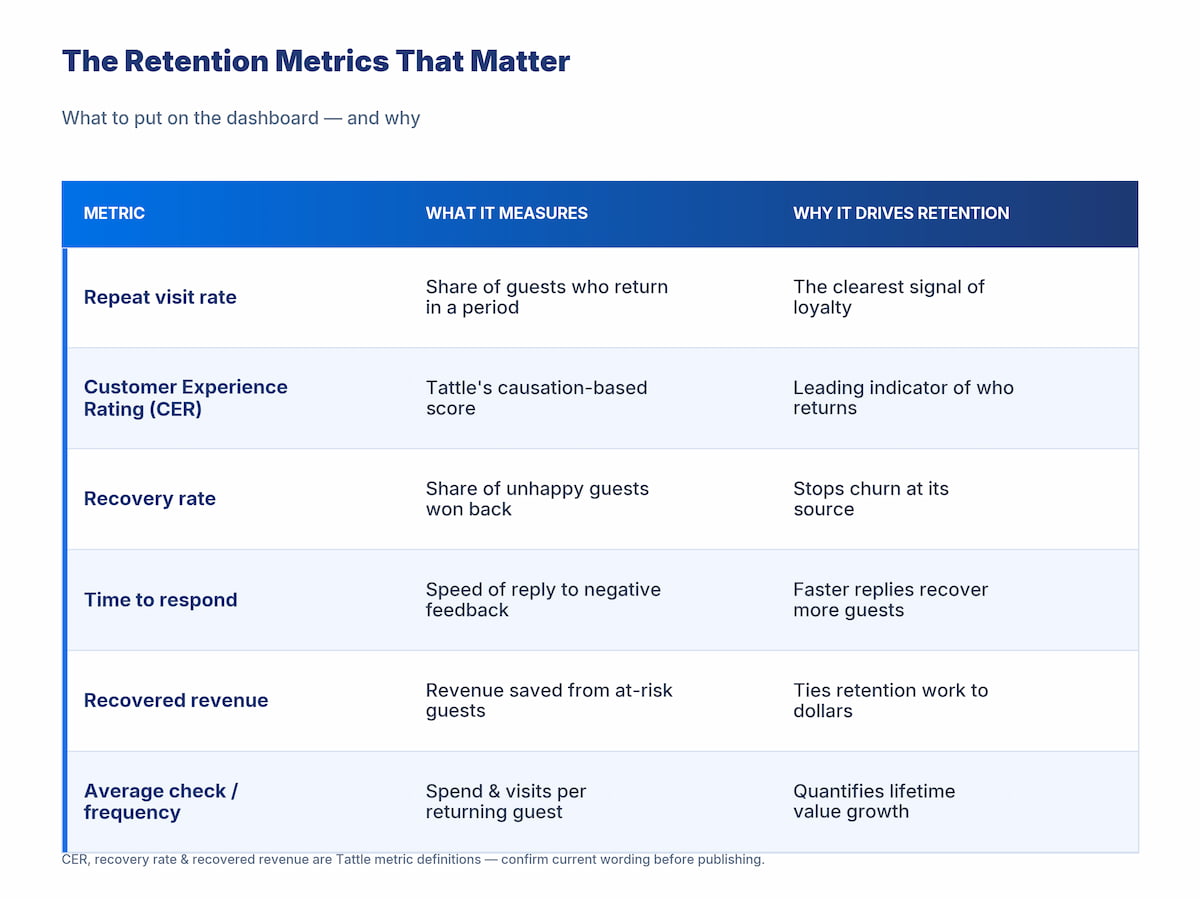
You can't improve what you only measure after it's gone. Lagging metrics (last quarter's same-store sales) tell you what already happened. Leading indicators — satisfaction scores, recovery rate, time-to-respond — tell you who is about to leave while you can still do something about it.
Put these on the dashboard and review them weekly, not quarterly:
Running all seven plays manually — across dozens or hundreds of locations — is where most retention programs stall. Tattle is a Customer Experience Improvement (CXI) platform built specifically for multi-unit restaurant brands to operationalize exactly this:
See how one brand turned recovery into revenue in the MOD Pizza case study, or request a demo to map these plays to your own locations. You can also estimate the impact on your brand.
What is a good customer retention rate for a restaurant? Restaurant retention rates average around 55%, below the ~75% benchmark seen across industries. Anything consistently above the industry average is a strong position; the more useful goal is steady improvement quarter over quarter against your own baseline.
Is it cheaper to retain a restaurant customer or acquire a new one? Retaining is far cheaper. Across industries, acquiring a new customer is estimated to cost 5–25× more than keeping an existing one, and in restaurants specifically the gap is often cited at 5–7×. Returning guests also spend more per order, so the ROI gap is even wider than the cost gap alone.
What are the best customer retention strategies for restaurants? The highest-impact strategies are: closing the feedback loop with causation-based surveys, recovering unhappy guests quickly, driving consistency across locations, rewarding visit frequency through loyalty, personalizing follow-up, managing public reviews, and tracking leading indicators of return.
How do I get more repeat customers at my restaurant? Focus on the first return visit. Most first-time diners never come back, so the biggest gains come from a great initial experience, fast recovery when something goes wrong, and a relevant, well-timed follow-up that gives the guest a reason to return.
How do you calculate restaurant customer retention rate? Use ((guests at end of period − new guests acquired) ÷ guests at start of period) × 100. For example, starting with 1,000 guests, ending with 1,100, and acquiring 300 new ones yields an 80% retention rate.
Why are restaurants losing repeat customers in 2026? Loyalty is becoming less habitual — a large share of diners now switch favorite brands within a year. The common causes are inconsistent experiences across locations, slow or absent recovery after a bad visit, and generic loyalty programs that don't change behavior.
How does Tattle help with restaurant customer retention? Tattle is a Customer Experience Improvement platform for multi-unit restaurants. It collects causation-based feedback across every channel, flags at-risk guests for fast recovery, turns location-level feedback into GM action items via AI Coach, and unifies public reviews with private feedback — so retention work happens systematically across all locations.
In 2026, the cheapest growth available to most restaurant brands is the revenue they're currently leaking. Retention beats acquisition on cost, on margin, and on durability — and the plays to improve it are well understood. The hard part is running them consistently across every location, which is exactly the gap a purpose-built CXI platform closes.
Ready to run the playbook? See how Tattle helps multi-unit brands recover guests and lift retention →