Insights & Updates
Latest from Tattle
Discover trends, tips, and insights to elevate your restaurant operations.
Discover trends, tips, and insights to elevate your restaurant operations.
 The Tattle Team
For a multi-unit restaurant brand, your Google rating is the storefront. It is the first thing a hungry guest sees in the local pack, in Maps, and increasingly in AI-generated answers when someone asks an assistant where to eat nearby. Three things drive how that storefront performs: the average star rating, the number of reviews, and how recent those reviews are. A strong, fresh, high-volume review profile lifts visibility in local search and gives undecided guests a reason to choose you over the place next door.
Before any tactic, understand the line you cannot cross. Review gating is the practice of screening guests by sentiment before deciding who gets asked for a public review. In a restaurant, it usually looks like a survey that asks “How was your visit?” and then sends satisfied guests to Google while quietly routing unhappy guests to a private feedback form that never sees daylight. It produces a review profile that looks clean because the negative voices were filtered out.
That practice is prohibited on every major front. Google’s Maps user-generated content policy explicitly bans “discouraging or prohibiting negative reviews, or selectively soliciting positive reviews from customers.” Yelp’s guidelines take the same position. And in the United States it is now federal law: the FTC’s Trade Regulation Rule on the Use of Consumer Reviews and Testimonials (16 CFR Part 465) took full effect on October 21, 2024, and treats review gating as illegal review suppression.
This is not theoretical. The FTC can seek civil penalties of up to $53,088 per violation, and in December 2025 it sent warning letters to ten companies in its first enforcement wave under the rule, signaling a shift from education to action. On the platform side, Google reported removing more than 292 million policy-violating reviews in 2025 and, in April 2026, rolled out AI-powered pre-publication detection that flags manipulation patterns before a profile ever shows them. A gated profile that looks too clean is itself a signal.
The takeaway for operators: any vendor, agency, or platform that offers “sentiment routing,” “skip-and-display logic,” or a workflow that sends happy guests to Google and unhappy guests somewhere private is selling you a compliance violation. The restaurant whose name is on the Google profile carries the liability, not the vendor. The good news is that you do not need gating to win. Generalized review requests sent to every guest are explicitly permitted by the FTC rule, and they work.
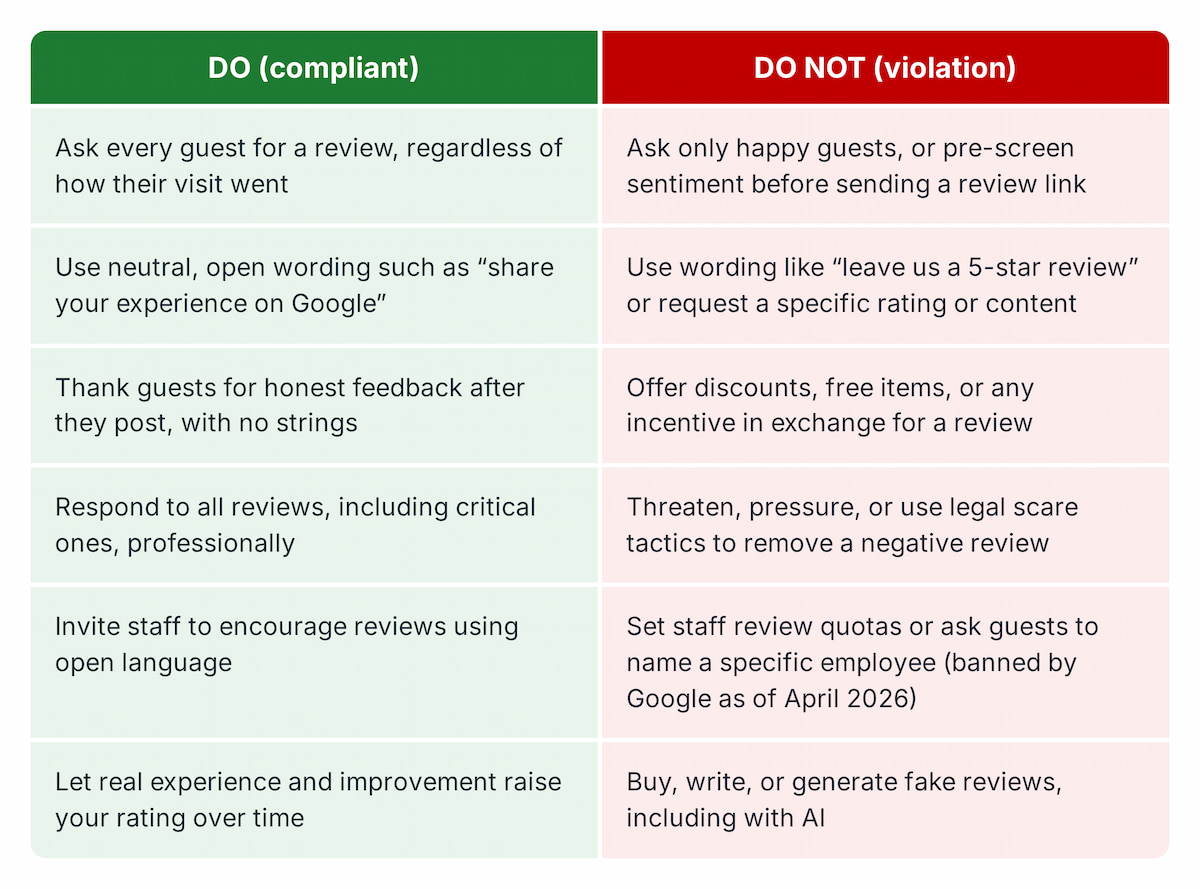
Every tactic below grows review volume and rating the right way. None of them filter guests by sentiment, and none of them put your brand at risk.
Ask every guest, not just the happy ones. The fastest compliant path to more reviews is also the simplest: invite all guests to review you, every time, with no sentiment filter in between. Equal opportunity is the heart of the rule, and asking everyone almost always produces more positive reviews anyway, because most guests have a good experience.
Use neutral, open language. Frame the ask as an invitation to share an honest experience, never as a request for a particular rating. “We’d love your feedback on Google” is compliant. “If you loved it, leave us five stars” is not. Open wording also keeps you clear of Google’s April 2026 rule against requesting specific content.
Time the ask to the moment. Reviews are easiest to capture when the experience is fresh. Prompt guests right after the meal or shortly after an online or delivery order is completed. The closer the ask is to the visit, the higher the response rate and the more accurate the review.
Make leaving a review effortless. Every extra tap costs you reviews. Use a direct Google review link, a QR code, or a one-tap button that drops the guest straight onto your review form. Remove logins, menus, and detours wherever you can.
Put the ask everywhere in the guest journey. Receipts, table tents, to-go bags, delivery inserts, confirmation texts, email footers, and post-visit surveys are all natural touch points. Consistency across locations is what turns a trickle of reviews into a steady stream.
Automate the request after every visit. Manual asks depend on a busy team remembering. An automated, sentiment-neutral request sent after each visit or order runs on its own and scales across every location. Automation plus immediacy is the single biggest lever on review volume. Tattle surveys can automatically prompt your guests to rate you online at the end, so they’re most likely to act on it in the moment.
Respond to every review, starting with the negative ones. Replies are public and they matter. A calm, specific response to a one-star review shows future guests you take problems seriously, and it often nudges the original guest to update their rating. Unanswered criticism reads as an unanswered accusation.
Fix the root causes that pull your rating down. The most durable way to raise a rating is to earn it. If slow service at dinner or cold food on delivery keeps surfacing, fixing the operational cause lifts genuine ratings far more reliably than any review campaign. This is where structured guest feedback earns its keep, and where Tattle comes in to help.
Train and motivate staff the compliant way. Encourage your team to invite reviews using open language. Do not set per-employee review quotas and do not script guests to mention a server by name, both of which Google explicitly banned in April 2026. You can reward staff for delivering great service that earns reviews; you cannot reward them for the reviews themselves.
Never incentivize, fake, or gate. No discounts for reviews, no employee-written reviews without disclosure, no purchased reviews, and no sentiment routing. These are the practices that trigger Google removals and FTC penalties. Volume earned honestly compounds; volume manufactured dishonestly collapses the moment it is detected.
Most restaurants do not lose reviews because they lack a tactic. They lose them because the asking is inconsistent across locations, and because the experience itself has fixable issues that keep dragging the rating down. Tattle, a Customer Experience Improvement platform built specifically for multi-unit restaurant brands, addresses both, and it does so inside the compliance lines drawn above.
A generalized review prompt that goes to every guest. At the end of a Tattle survey, every guest sees the same “Leave a Review” button, regardless of how they rated their visit. There is no branching, no sentiment filter, and no separate path for unhappy guests. That is exactly the generalized solicitation the FTC rule permits, and it is the opposite of gating. Guests who complete a survey are simply invited, on equal terms, to share their experience publicly.
“I’ve seen in SOCi that our stores are getting more Google reviews and higher ratings, since we started prompting guests in Tattle surveys,” said Nina Johnson, Guest Relations Manager at Sonny’s BBQ.
Causation-based analysis and the Monthly Objective that raise the real rating. Collecting feedback is common; knowing which factors actually move guest satisfaction is not. Tattle’s causation-based analysis pinpoints the specific operational drivers behind a location’s scores, and the Monthly Objective turns that into one clear, prioritized focus for each location each month. Fix the thing that genuinely frustrates guests, and the higher ratings that follow are earned, durable, and fully compliant. Service recovery in this model is about making the next visit better, never about hiding the last review.
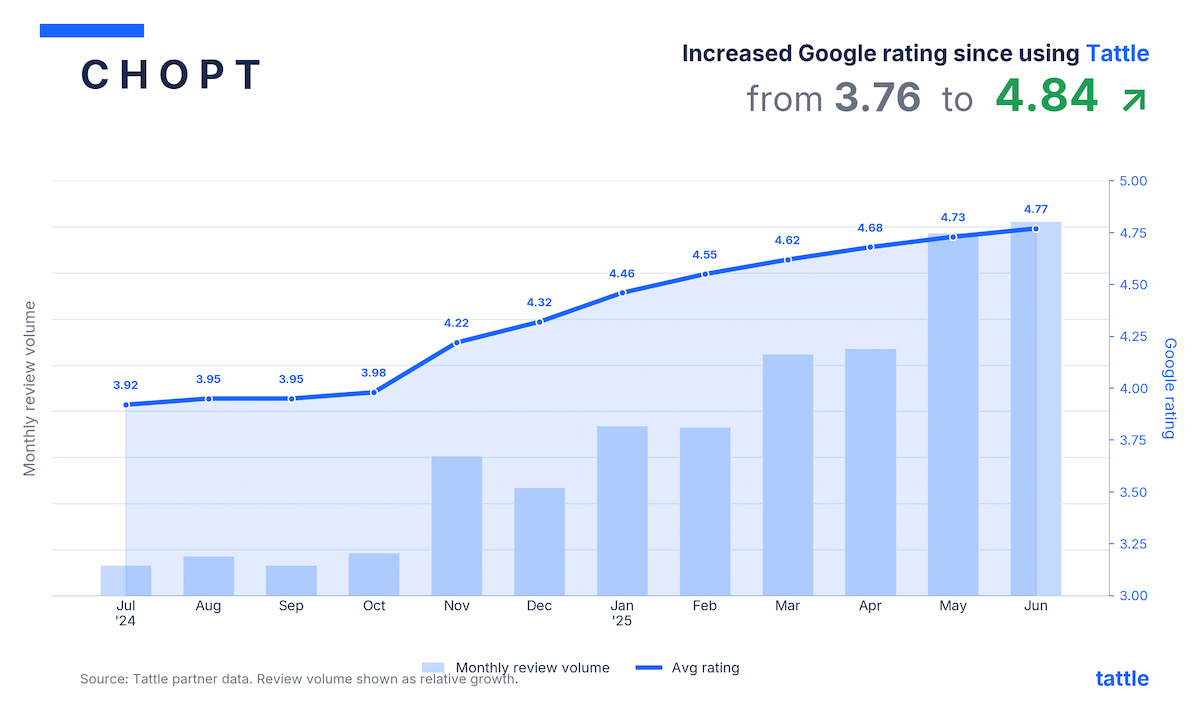
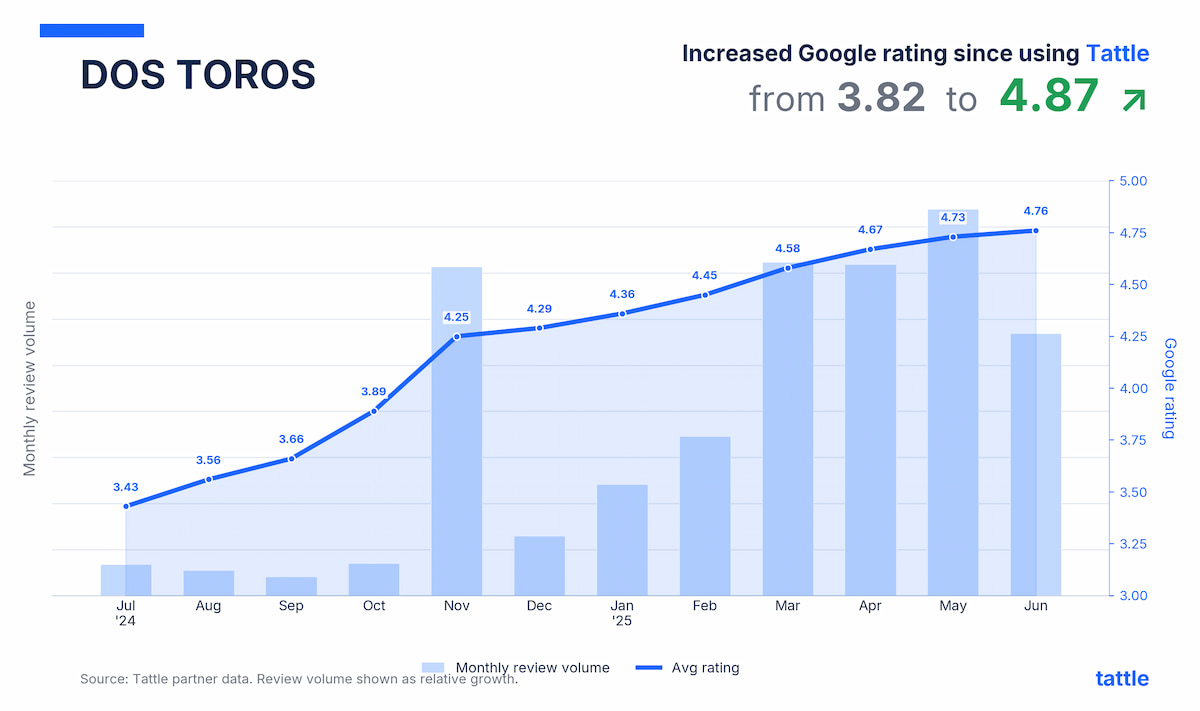
Volume rises with rating, not at its expense. At Chopt, monthly Google review volume grew from roughly 332 to more than 4,000 over the measured period while the average rating climbed from 3.92 to 4.77. Dos Toros saw a similar pattern. More reviews and a higher rating moved together, which is exactly what you expect when you invite every guest and improve the experience underneath them.
Across Tattle’s restaurant partners, the pattern is consistent: as the experience improves and every guest is invited to review, public Google ratings climb. A sample of partner results:
If you want the full mechanics of compliant collection, routing, and response at scale, see Tattle’s review management capabilities.
Invite every guest to review you, keep the request neutral and easy, time it right after the visit, automate it across locations, respond to every review, and fix the operational issues that lower your rating. Volume grows when you ask everyone consistently and earn the rating you display.
Yes. Asking all of your customers for honest reviews is fully legal and explicitly allowed by the FTC. These generalized requests are encouraged. What is illegal is selectively asking only happy customers, paying for reviews, or suppressing negative ones.
Review gating is screening guests by sentiment and only sending satisfied ones to leave a public review while diverting unhappy ones to a private form. It is not allowed. Google and Yelp prohibit it, and the FTC treats it as illegal review suppression with penalties up to $53,088 per violation.
No. Offering any incentive such as a discount, free item, or loyalty points in exchange for a review violates both Google’s policy and the FTC rule, which bars compensation conditioned on a review or a particular sentiment. You can thank guests after they review you, with no strings attached.
No. Asking only satisfied guests is the textbook definition of review gating and is prohibited. Every guest must have the same opportunity to leave a public review, whatever their experience was.
There is no fixed number. What matters is a steady flow of recent, authentic reviews and a strong average rating relative to nearby competitors. Recency and consistency carry real weight in local search, so a continuous trickle beats a one-time burst.
Automate a neutral review request to every guest after each visit, make it one tap to complete, respond to all reviews, and improve the experience so the ratings you earn are genuine. That is the entire compliant playbook, and it is what platforms like Tattle operationalize for multi-unit brands.