Insights & Updates
Latest from Tattle
Discover trends, tips, and insights to elevate your restaurant operations.
Discover trends, tips, and insights to elevate your restaurant operations.
 The Tattle Team
The order was wrong. The wait ran 20 minutes long. The food came out cold. That part is done, and you cannot undo it.
Service recovery in restaurants is what you do next: how you handle the guest after a visit goes wrong so they stay a customer instead of quietly disappearing.
Here is the part most operators get wrong, and it is worth knowing before you read another word. A great recovery repairs how a guest feels. It does not move what they do next. A review pooling the published studies found a clear lift in satisfaction and no reliable effect on whether guests came back, told anyone, or thought better of the brand. A guest can leave happier than if nothing had gone wrong and still not come back. The next visit is earned by the problem not happening again.
So recovery is half the job. The other half is fixing what caused it.
The short version
- Do not build a plan around the service recovery paradox. Recovery moves how guests feel, not what they do next. Treating mistakes as loyalty chances is a bad bet.
- Recovery is still worth doing, and there is a right size for it. Make the remedy worth most of the bill, then stop.
- Repeat visits come from fixing the cause. Satisfaction is not a visit. The guest coming back and not hitting the same problem is. That is an operations job, not a service gesture.
The rest of this guide is the evidence for those three points, plus the workflow, the comp numbers and the metrics to run it.
In this guide
- What service recovery means in a restaurant
- The service recovery paradox, and what the research really found
- Why this matters more in restaurants
- The guests who never say anything
- A five step recovery workflow
- How much to take off the bill
- What to say to an unhappy guest
- Five numbers worth tracking
- Common mistakes
- How leading multi-unit brands do this with Tattle
- FAQ
Service recovery is everything a restaurant does after a visit goes wrong to fix the problem and keep the guest. That includes the response in the moment, the follow up afterward, whatever you take off the bill, and the fix that stops it happening again.
Three things get mixed up here. They are not the same:
The difference matters, and it is where the money leaks. Most brands are decent at complaint handling and review replies. Far fewer close the loop. They answer the guests who speak up in public, then leave the kitchen problem exactly where it was, which guarantees the next guest hits it too.
The service recovery paradox is the idea that a guest who has a problem and then gets a great fix ends up happier than a guest whose visit went perfectly. Two researchers, McCollough and Bharadwaj, named it in 1992.
The logic is simple. A problem lowers what the guest expects next. So a strong response clears a lower bar and feels like a pleasant shock.
It is the most repeated idea in hospitality. It is also oversold, and the real story is more useful.
The best evidence comes from a 2007 review in the Journal of Service Research by de Matos, Henrique and Rossi. They pooled the published studies on the paradox and looked at four outcomes.
Great recovery clearly lifted how satisfied guests felt. On the other three outcomes, the studies did not show a reliable effect: whether guests came back, whether they told other people, and what they thought of the brand.
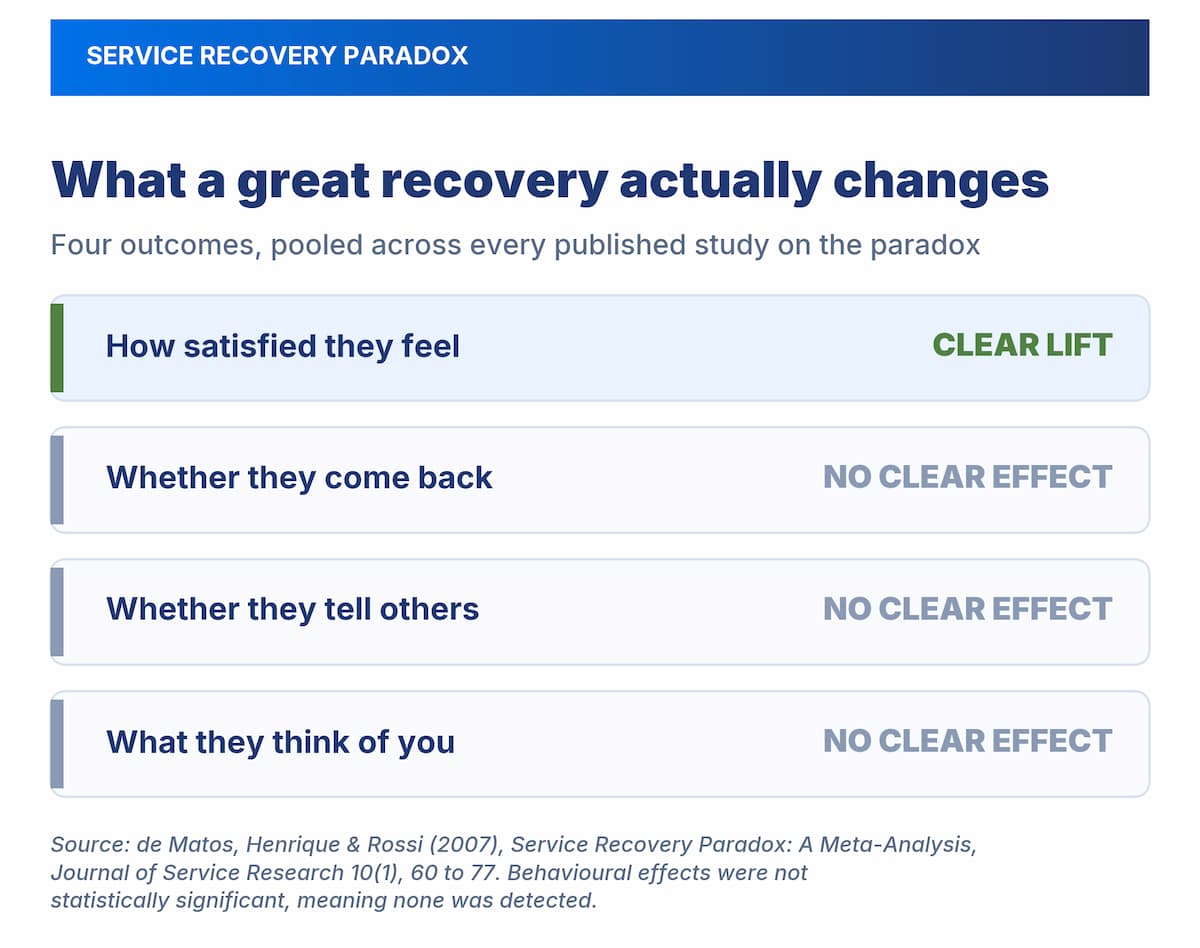
Read that again, because it is the whole point of this article. A great recovery makes a guest feel better. It does not, on its own, bring them back.
On satisfaction itself, the literature genuinely disagrees, and it is worth knowing where the argument sits. The pooled effect supports the paradox: recovery can leave a guest more satisfied than a clean visit would have. Individual studies have found the reverse. McCollough, Berry and Yadav, writing in the same journal in 2000, ran two experiments and found satisfaction stayed below error-free service even when recovery performance was high.
That argument is unresolved. For an operator it also does not matter much, because both sides agree on the part that pays. Nobody has shown that failing and recovering beats not failing on return visits or word of mouth. Feeling better is not the same as coming back.
The paradox is real, but only for the outcome that matters least on its own. Satisfaction is the input. The return visit is the output, and the pooled studies do not connect recovery to it.
That is why step 4 of the workflow below is the one that pays. Reaching the guest saves the relationship today. Removing the cause is what makes the next visit different, and it is the only part of this a competitor cannot copy from your comp policy.
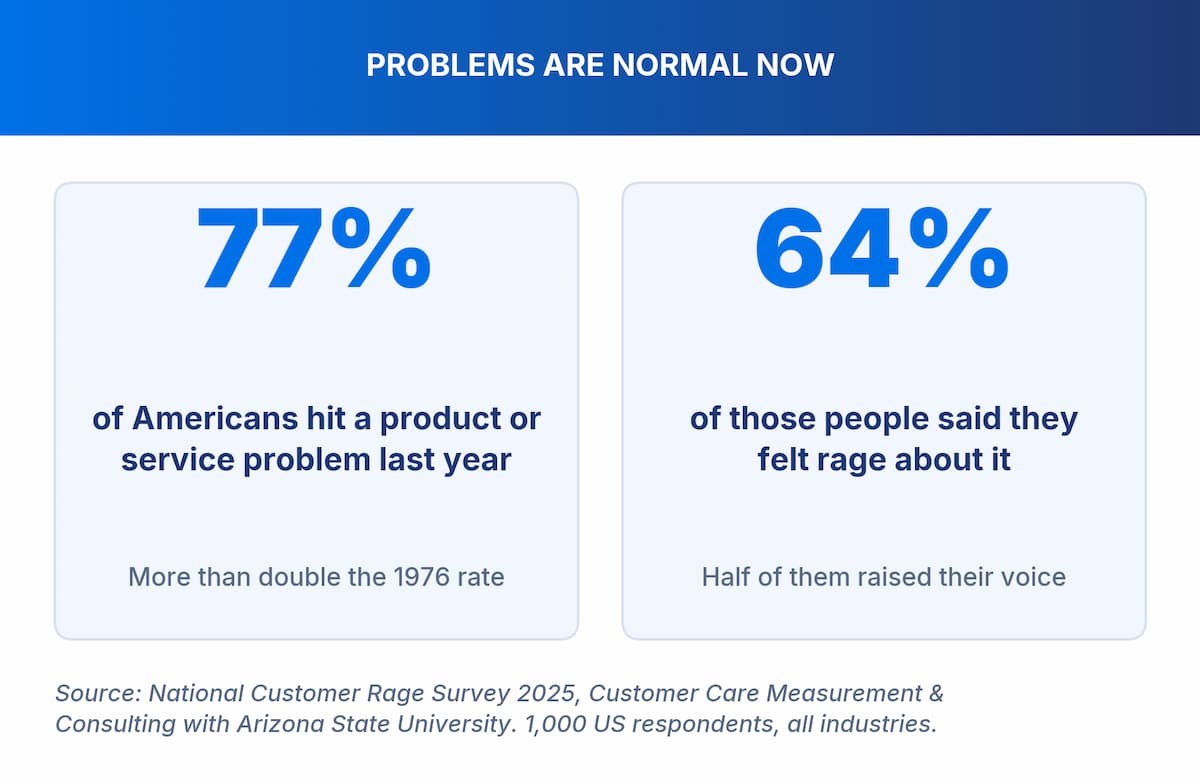
Problems are normal, and they are getting more common. In the 2025 National Customer Rage Survey, run by Customer Care Measurement & Consulting with Arizona State University’s Center for Services Leadership, 77% of Americans said they had a product or service problem in the past year. That rate has more than doubled since 1976. The survey covers all industries, not restaurants alone, but the direction is hard to ignore.
Among the people who had a problem, 64% said they felt rage about it, and half raised their voice. The researchers call that voice-raising figure a record high.
Complaints have also moved into public view. The same survey found more people now complain through email, chat and social media (45%) than by phone (33%). One in four people who complained posted about their worst problem on social media. Of those, 43% said the company never replied.
So the complaint you do get is more likely to be public, and nearly half of public complaints go unanswered.
The guests who complain are the easy ones. They told you what happened. You know who they are. They still care enough to say something.
The costly ones say nothing at all. They rate the visit a 3, write “it was fine,” and never come back.
You will see a lot of confident statistics online about what share of unhappy customers stay quiet. Most trace back to no identifiable study. We are not going to repeat them. The honest version is simpler: surveys can only count people who spoke up, so nobody has a clean number for the ones who did not. What is measured is narrower: among people who post publicly about a serious problem, more than 4 in 10 never hear back.
Either way the lesson is the same. If your recovery process only starts when someone complains, you are working from the small, loud slice of your actual problems. You will look like you are doing fine the whole time.
That is why finding the problem is step one, not an afterthought. Asking every guest how the visit went is very different from waiting for the ones who are angry enough to call.
For more on how quiet non-returns drain a multi-unit business, see Fix the Leaky Bucket: Reduce Restaurant Churn with Guest Feedback.
Recovery is a workflow, not a policy binder. Here are the five steps and how fast each one needs to happen.
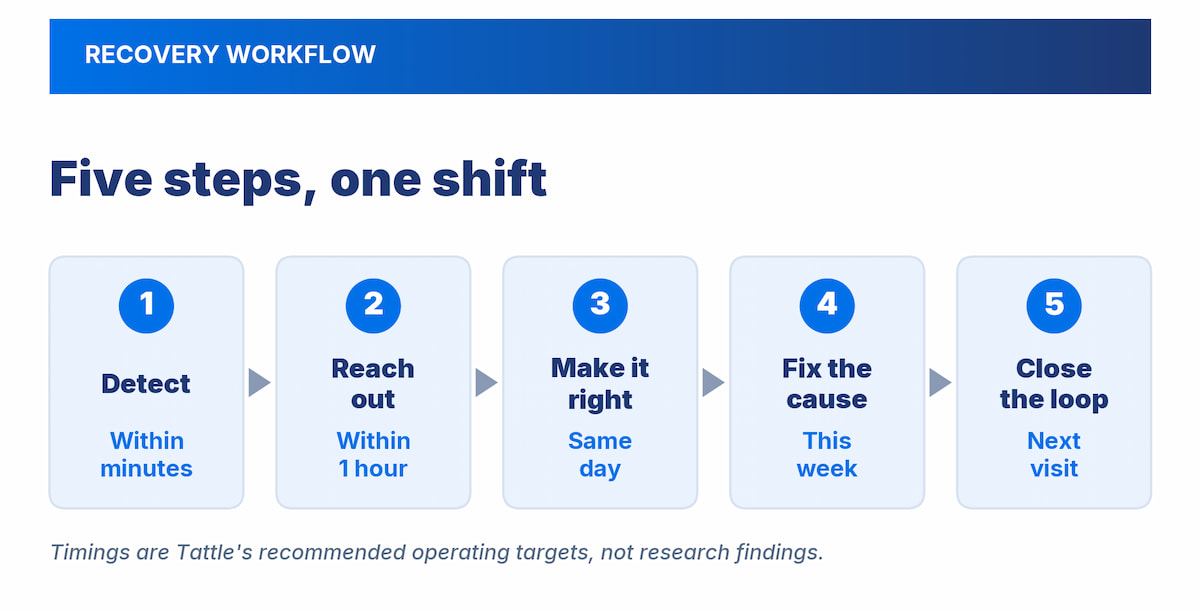
Ask every guest how the visit went, right after they leave, while they still remember it. Set triggers that fire on their own: a low overall score, a low score on something critical like order accuracy, or a bad comment on a keyword you care about. Send the alert to the general manager of that store. Not to a corporate inbox.
Speed is where most brands lose. An apology is worth less every hour it waits. A guest you reach while the visit is still fresh is a much easier save than one who has already vented to their table and posted a review.
Name the actual problem. “We saw your Tuesday order took much longer than it should have” does something that “sorry your experience fell short” does not.
Keep it easy for them. Research by the Corporate Executive Board, published in Harvard Business Review, looked at more than 75,000 people and found that what builds loyalty is removing effort, not adding flourishes. People want a simple, quick fix. Big gestures barely moved loyalty at all. That study covered contact centers and self-service channels rather than restaurants, but the point carries: fast and specific beats fancy.
Match the fix to the problem. Replace a cold entree, do not discount it. Answer a long wait with priority next time, not a free dessert. A mismatched offer reads as a brush off, because it shows you did not read what the guest said.
Let the general manager settle things up to a set dollar amount without asking anyone. Hart, Heskett and Sasser made this case in Harvard Business Review back in 1990, and it still holds: give front line staff the authority to fix the mistake, even if that means bending the rules. Every approval step is time you do not have.
This is the step that separates real recovery from theater. It is also the one the research says earns the return visit.
One low score is an incident. The same low score showing up across a shift, a daypart or a store is a broken process. Comping guests through a broken process forever costs more than fixing it.
Give each store one or two specific changes with a name attached, not a long list of observations. Prep timing on one item. One station’s build order. Staffing for the 11:30 rush.
Recovery is not finished when the guest replies. It is finished when they come back and the next visit is clean.
Flag recovered guests so you can compare their next visit to the bad one. If the same thing goes wrong twice for the same guest, that is a conversation with store leadership, not another comp.
Most brands guess. That produces two bad habits: token gestures that fix nothing, and reflex comping that eats margin and teaches guests to complain.
One study actually measured it. In 2022, Edström and colleagues published two experiments in the Journal of Service Theory and Practice. They tested different make-good amounts to find the point where a guest with a problem came back up to the level of a guest who had none.
Their test used a different service setting, so the amounts below are their findings scaled onto a $24 restaurant check purely to make them easy to picture:
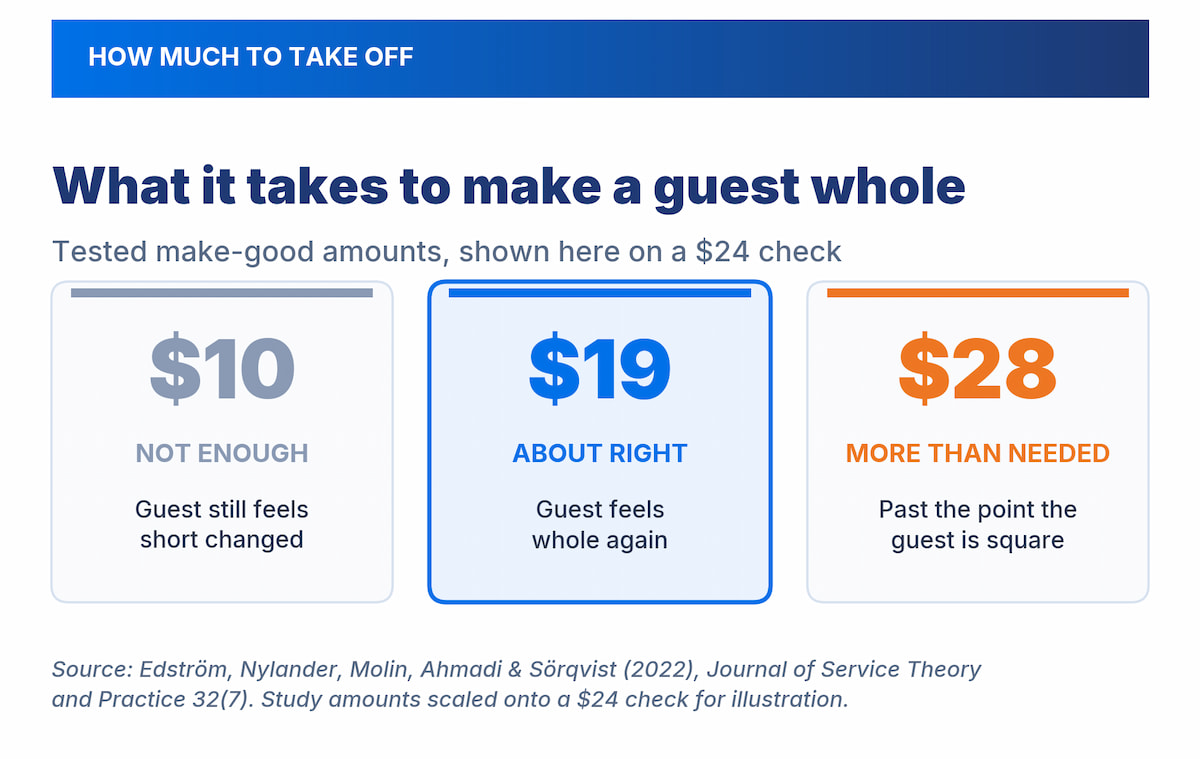
About $10 back was not enough. Around $19 back, guests felt whole again. The authors describe the top level, about $28 back, as unnecessary overcompensation: it goes past the point where the guest is already square with you.
In plain terms: make it worth most of the bill, then stop. A 10% off coupon is too small to repair anything. A comped check plus a gift card is more than you need.
Two honest caveats:
The exact wording matters less than most training decks claim. A few things hold up.
Name what happened. Guests can tell a real message from a template. Saying the actual problem out loud is the cheapest credibility you will ever get.
Skip the reason. Nobody wants to hear that you were short staffed. Explanations sound like excuses, even true ones.
Do not give them homework. A form to fill in, a number to call, a code that only works in store. Every extra step is more work for someone you already let down.
Do not ask for a review in the same breath. Beyond the bad timing, tying a reward to whether a review is positive is prohibited outright by the FTC’s Rule on the Use of Consumer Reviews and Testimonials (16 CFR Part 465). Sorting guests by mood, sending the happy ones to review sites and steering the unhappy ones elsewhere, is a separate problem: it runs against the review platforms’ own policies. Keep recovery and review requests as two separate motions with separate triggers.
Tell them what you changed. “Here is what we did about it” beats an open ended apology. It is also the only version that makes the next visit feel different.
Recovery programs drift when nobody measures them. Five numbers are enough.
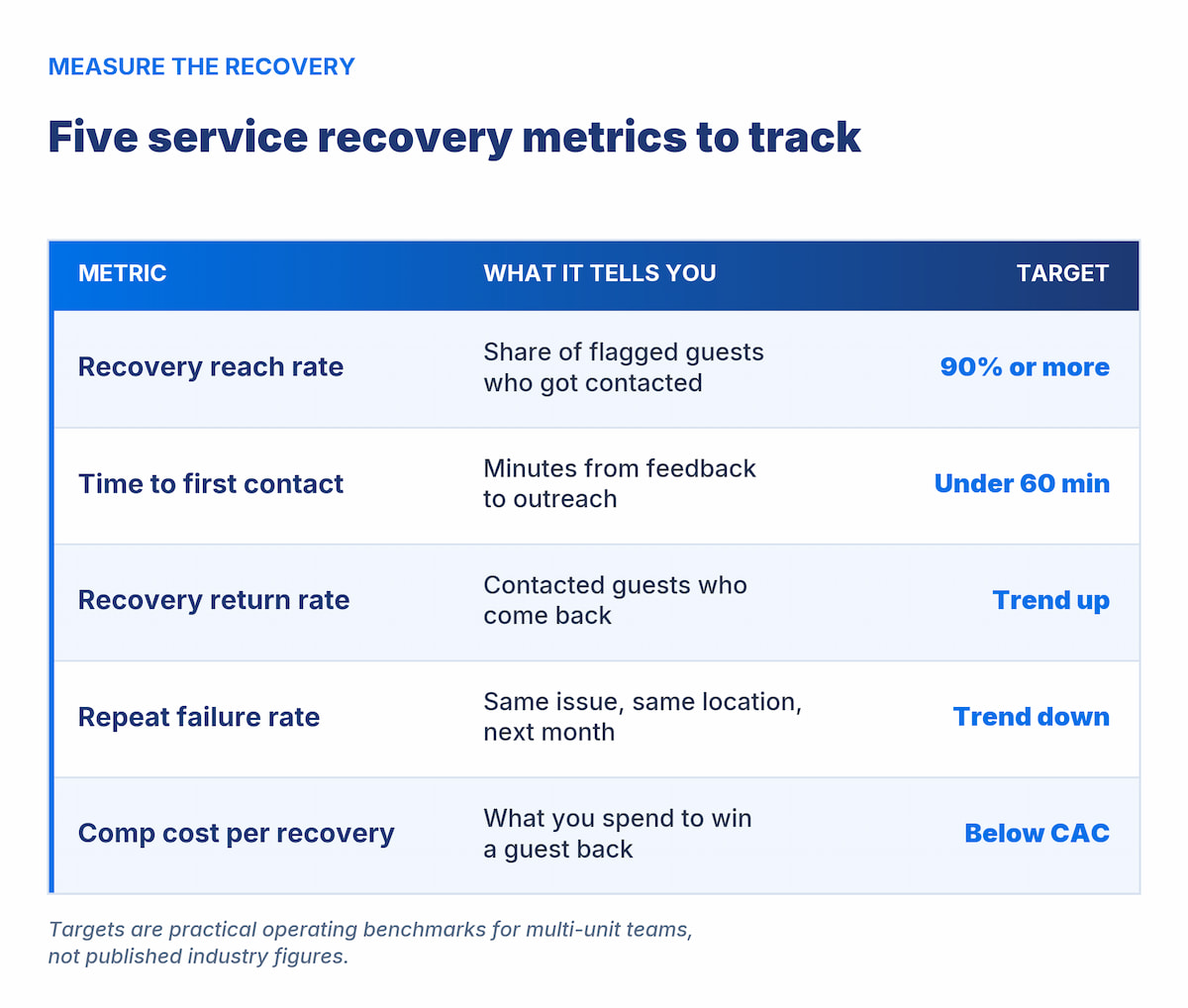
The first two tell you whether the workflow is running at all. Recovery return rate tells you whether it works. Repeat failure rate is the honest one: if it stays flat while comp spend climbs, you are paying to work around a problem instead of fixing it. Comp cost per recovery keeps the whole thing defensible next to what you spend to win a new guest.
Tattle is a Customer Experience Improvement platform for multi-unit restaurants. The workflow above maps onto it fairly directly.
Find every problem, not just the loud ones. Feedback collection asks every guest how the visit went across dine-in, drive-thru, pickup and delivery. The surveys are built to show which part of the operation moved satisfaction, not just a star rating, which is what makes step 4 possible at all.
Reach the guest inside the window. Guest Recovery flags unhappy guests in real time and sends them to the store that can act, so outreach happens in the hour rather than at next week’s meeting.
Fix the cause store by store. AI Coach turns each store’s feedback into a short, ranked list of things to change. That is the gap between knowing speed is a problem and knowing which station at which daypart.
Keep reviews separate. Review Management handles public reviews as their own workflow, which is cleaner to run and the right side of the FTC rule above.
For a worked example, the MOD Pizza success story is the closest reference point.
What is service recovery in a restaurant? Service recovery is everything a restaurant does after a visit goes wrong to fix the problem and keep the guest. It covers finding the problem, reaching the guest, making it right, and fixing whatever caused it so it does not happen again.
Is the service recovery paradox real? Only partly. A 2007 review in the Journal of Service Research pooled the published studies and found that great recovery clearly lifted how satisfied guests felt, but showed no statistically significant effect on whether they came back, told other people, or thought better of the brand. So a guest can leave happier than if nothing had gone wrong and still not return. Recovery moves how guests feel, not what they do next.
How fast should a restaurant respond to a bad guest experience? Within an hour of getting the feedback, and the same day at the very latest. An apology is worth less every hour it waits, and a guest who has already posted a public review is much harder to win back than one you reach while the visit is fresh.
How much should a restaurant take off the bill for an unhappy guest? Research published in 2022 in the Journal of Service Theory and Practice found that guests felt whole again when the make-good was worth most of what they paid, not a token discount, and that going beyond that added nothing. On a $24 check, about $10 back was too little and about $19 back did the job. It was run in a different service setting, so treat it as a starting range rather than a rule.
What is the best way to handle an unhappy customer in a restaurant? Name the specific problem, fix it fast, and do not make the guest do any work. Corporate Executive Board research published in Harvard Business Review looked at more than 75,000 people and found that removing effort builds loyalty while big gestures barely register.
Do most unhappy restaurant guests complain? No, and nobody has a reliable number for how many stay quiet, because surveys can only count people who spoke up. What is measured is that complaints have moved online and often go unanswered: the 2025 National Customer Rage Survey found 45% of people complain through digital channels versus 33% by phone, and 43% of those who posted about a serious problem on social media got no reply.
How do you measure whether service recovery is working? Track recovery reach rate, time to first contact, recovery return rate, repeat failure rate, and comp cost per recovery. Repeat failure rate is the most revealing: if comp spend is rising while repeat failures stay flat, you are paying to work around a problem instead of fixing it.
How does Tattle help with service recovery? Tattle asks every guest how their visit went across every channel, flags unhappy guests in real time through Guest Recovery so the store can reach out inside the hour, and turns each store’s feedback into a ranked list of fixes through AI Coach so the cause gets solved instead of comped again next month.
The mistake already happened. What you control is the next hour, and whether the cause is still sitting there when that guest comes back.
The research is clear about what recovery buys and what it does not. It repairs how a guest feels. It does not buy back the visit. The brands that turn recovery into retention treat the guest outreach and the kitchen fix as one job, and they measure the second one as seriously as the first.
See how Tattle turns guest feedback into recovery, store by store. Request a demo.