Insights & Updates
Latest from Tattle
Discover trends, tips, and insights to elevate your restaurant operations.
Discover trends, tips, and insights to elevate your restaurant operations.
 The Tattle Team
If you are looking for a Birdeye alternative for your restaurant brand, you are probably already managing reviews on some platform and wondering whether a horizontal reputation tool is the right fit for a restaurant-specific job, or you are evaluating a few vendors before signing a multi-location contract. Either way, the decision usually comes down to the same question: do you want a platform built to manage reviews and listings across many industries, or one built specifically around why restaurant guests are satisfied or not.
This guide compares Birdeye’s reputation management platform against Tattle’s restaurant-focused customer experience approach: what each one does, who it is built for, roughly what it costs, and how to think about the tradeoffs before you commit.
In this guide:
- What Birdeye is and who it is built for
- What a Birdeye pricing structure typically looks like
- Why restaurant operators go looking for a Birdeye alternative
- A feature-by-feature comparison of Birdeye and Tattle
- The compliance rules that apply to any review-generation strategy
- How multi-unit restaurant brands use Tattle differently
- FAQ covering the questions operators ask most
Birdeye is a reputation and customer experience management platform that helps multi-location businesses monitor reviews, manage business listings, and communicate with customers from one dashboard. It serves businesses across many industries, not restaurants alone, including healthcare, retail, financial services, and home services, and it markets itself as an agentic AI platform for brands managing anywhere from a handful to thousands of locations.
According to Birdeye’s own site, the platform aggregates reviews from more than 200 review sites, connects with more than 3,000 business apps and systems (including restaurant platforms such as Toast, OpenTable, Grubhub, ChowNow, and Square), and uses a set of AI agents, including Reviews AI, Listings AI, Search AI, and Social AI, to automate review requests, responses, and listing updates. Birdeye states that more than 200,000 businesses use the platform.
For restaurant brands specifically, Birdeye’s pitch centers on visibility: making sure a location’s listings are accurate across Google, Apple Maps, Yelp, and other discovery surfaces, and making sure review volume and response times stay healthy across every location.
Based on third-party pricing research, Birdeye’s plans are generally structured as follows:
Because none of this is published directly by Birdeye, treat it as directional rather than exact. Get a current quote for your specific location count before budgeting against it.
A few reasons come up repeatedly when multi-unit restaurant brands evaluate whether to move off, or away from, a general-purpose reputation platform:
They want to know why satisfaction is moving, not just what it says. A star rating or a review volume dashboard tells you the outcome. It does not tell you whether a location’s rating dipped because of slow drive-thru times, an order accuracy problem, or a staffing gap on weekend closes. Platforms built around public review monitoring are, by design, working from the small percentage of guests who choose to leave a public review, not the full base of guests who visited.
They want the feedback tied to the actual visit. Public reviews arrive whenever a guest decides to write one, often days after the visit and often only from guests with a strong opinion in either direction. A structured, post-visit survey tied to the transaction captures a more representative sample and links feedback directly to a specific order, shift, and location.
They want to catch unhappy guests before the review goes public, not just respond quickly after it does. Responding well to a negative review is a good practice, but it is a recovery play after the fact. Some restaurant brands want a workflow that flags a dissatisfied guest in real time, while there is still a chance to make it right directly.
They are comparing per-location contract economics across a portfolio of tools (review management, survey platform, POS, loyalty) and want to understand whether consolidating onto a restaurant-specific platform reduces total vendor count and cost, rather than adding a general-purpose tool on top of what they already run.
None of this means Birdeye is a poor product. It is a broad, well-resourced platform built for a broad set of industries. The question for a restaurant brand is whether “broad” or “restaurant-specific” is the better fit for the problem you are actually trying to solve.
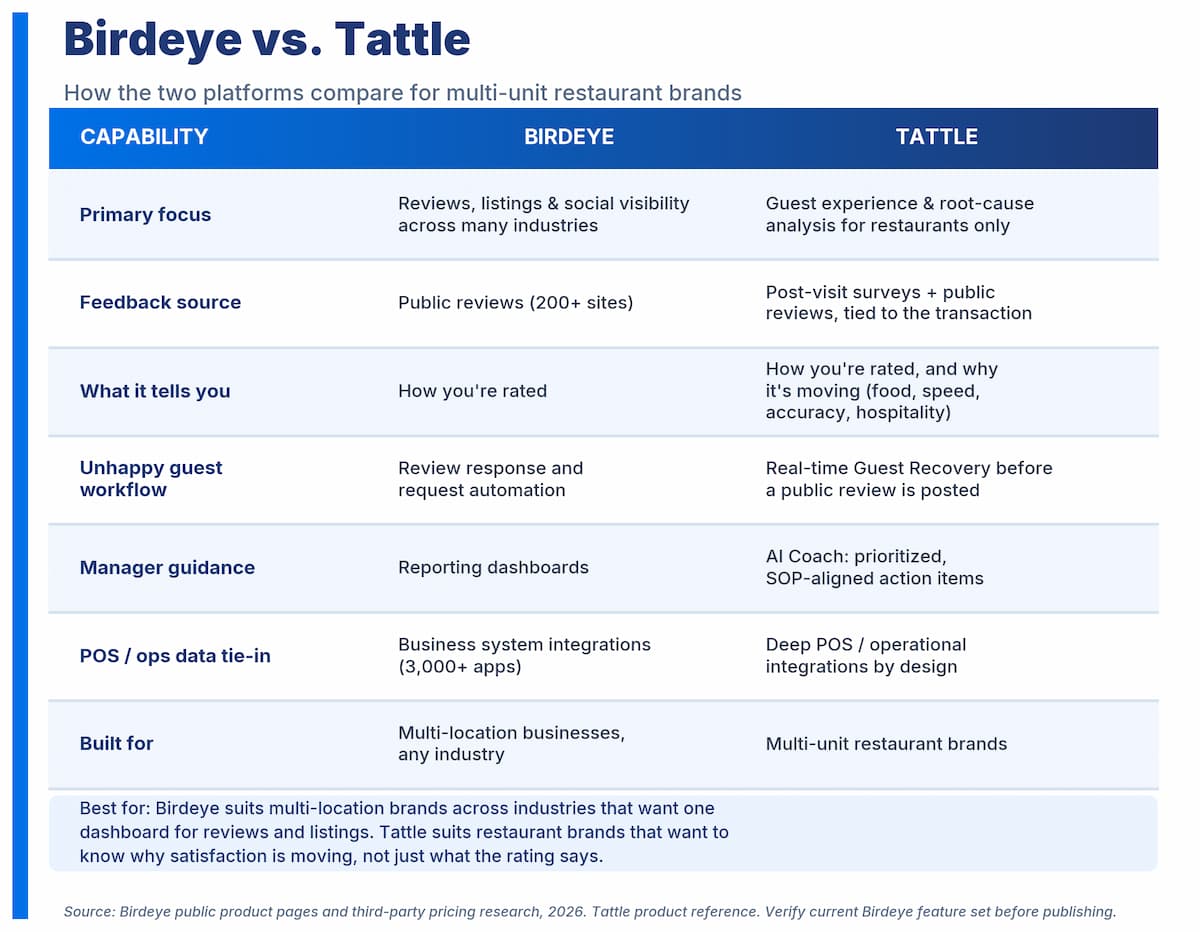
The short version: Birdeye is a horizontal reputation and visibility platform used across many industries. Tattle is a Customer Experience Improvement (CXI) platform built specifically for multi-unit restaurant brands, with causation-based surveys designed to isolate why satisfaction moved (food, speed, accuracy, hospitality) rather than only tracking the star rating that resulted from it.
Best for: Birdeye suits multi-location brands across industries that want one dashboard for reviews, listings, and social presence. Tattle suits restaurant brands that want to know why satisfaction is moving at the location level, and to act on it before a guest churns or leaves a public review.
The stakes here are not abstract. Michael Luca’s Harvard Business School study, “Reviews, Reputation, and Revenue: The Case of Yelp.com,” found that a one-star increase in a restaurant’s Yelp rating is associated with a 5 to 9% increase in revenue, an effect that was strongest for independent restaurants and smaller for chains with an already-established reputation.
On the demand side, BrightLocal’s Local Consumer Review Survey 2025 found that 71% of consumers read online reviews regularly when researching a local business, and only 4% say they never read reviews at all. Whatever platform you use to manage reviews and guest experience, the audience reading the results is not shrinking.
Any review-generation strategy, whether run through Birdeye, Tattle, or manually, has to operate within the same legal boundaries. The FTC’s Rule on the Use of Consumer Reviews and Testimonials (16 CFR Part 465), in effect since October 21, 2024, prohibits businesses from creating, buying, or disseminating fake reviews, and it bars offering compensation or incentives contingent on a customer leaving a positive review or a review with a particular sentiment. Violations can carry civil penalties.
The rule does not explicitly ban asking only satisfied guests for a review (commonly called “gating”), but the FTC has noted this practice can still raise concerns under the FTC Act’s endorsement guidelines if it misrepresents the overall balance of customer opinion. Google, Yelp, and most major review platforms also have their own policies against incentivized or solicited-only-from-happy-customers review requests. The safest approach, regardless of which platform you use, is to ask every guest for honest feedback and let the review fall where it may.
Tattle is a Customer Experience Improvement platform built for multi-unit restaurant brands. Instead of starting with the public review, Tattle starts with a structured, causation-based survey sent close to the time of the visit, designed to isolate which operational factor (food, speed, order accuracy, hospitality) is actually driving satisfaction up or down at each location.
Two capabilities map most directly onto the reasons operators go looking for a Birdeye alternative in the first place:
If your team is comparing platforms because you want to understand root cause, not just monitor star ratings, that is the core difference to evaluate: a reputation and listings platform built for many industries, versus a guest experience platform built specifically around why a restaurant’s satisfaction moves.
Ready to see how it works for a multi-unit brand? Request a demo or check pricing.
What is Birdeye used for? Birdeye is a reputation and customer experience management platform that businesses use to monitor and respond to online reviews, manage business listings across search and map platforms, and communicate with customers, primarily through AI-assisted automation for multi-location brands.
Is Birdeye good for restaurants? Birdeye supports restaurant brands alongside many other industries, and it integrates with common restaurant platforms like Toast, OpenTable, and Square. Whether it is the best fit depends on whether you need a broad reputation and listings tool or a platform built specifically around restaurant guest experience and operational root cause.
How much does Birdeye cost for a restaurant? Birdeye does not publish pricing publicly. Third-party research reports per-location monthly pricing that commonly ranges from the high $200s to the mid $400s depending on tier, with a custom enterprise tier above that. Confirm current pricing directly with Birdeye for your location count.
What is the best Birdeye alternative for restaurants? The right alternative depends on what problem you are solving. If you specifically need restaurant-focused, causation-based guest feedback tied to the visit, rather than a general reputation and listings platform, Tattle is built for that use case.
Can a restaurant only ask happy customers to leave a review? The FTC’s 16 CFR Part 465 does not explicitly prohibit asking only satisfied customers for reviews, but it does prohibit offering any incentive tied to a positive review, and major review platforms have their own policies against selective solicitation. The safer, compliant approach is to request feedback from every guest.
What is the difference between review management and guest experience management? Review management focuses on monitoring, responding to, and generating public reviews after a guest chooses to leave one. Guest experience management, as Tattle approaches it, collects structured feedback from every guest close to the time of the visit and ties it to the operational cause, so issues can be addressed before they show up as a public review at all.
Does Birdeye integrate with restaurant POS systems? According to Birdeye’s own materials, it integrates with more than 3,000 business apps and systems, including restaurant-specific platforms such as Toast, OpenTable, Grubhub, ChowNow, and Square.
How does Tattle help restaurants manage their online reputation? Tattle’s Review Management capability monitors and helps manage public reviews, while its Guest Recovery capability surfaces dissatisfied guests in real time so a team can address the issue directly, often before it becomes a public review. Because both connect to the same structured feedback data, a location’s rating and its underlying operational cause are visible in one place.
Tattle and Birdeye solve adjacent but different problems, and this guide describes Birdeye using its own published positioning and features rather than characterizing it negatively. If you are managing a multi-location restaurant brand and your primary need is broad reputation and listings coverage across a portfolio that spans multiple industries, Birdeye may be the right tool. If your primary need is understanding why guest satisfaction is moving at the restaurant level, and acting on it before a guest churns, that is the specific problem Tattle is built to solve.