Insights & Updates
Latest from Tattle
Discover trends, tips, and insights to elevate your restaurant operations.
Discover trends, tips, and insights to elevate your restaurant operations.
 The Tattle Team
Most restaurant operators know guest feedback matters. Far fewer understand exactly how it translates to revenue, or how many different places in the business it actually touches.
This is not about collecting more data for its own sake. It is about the specific, traceable ways that actively managing what your guests tell you drives more visits, higher check averages, better online ratings, and lower churn. Every item on this list is a real mechanism, not a theory.
The cheapest new customer is the one you never lost. Research from Bain & Company shows it costs 5 to 7 times more to acquire a new guest than to retain an existing one. In a business built on repeat visits, that math makes retention the highest-ROI sales lever available to a restaurant operator.
Guest feedback tells you why people stop coming back before they actually do. The most common drivers of silent churn are not dramatic failures. They are slow accumulations of mediocre experiences: food that came out lukewarm twice in a row, a server who seemed distracted, a wait time that stretched beyond what the guest felt was reasonable. Left unaddressed, those patterns quietly erode a restaurant's regular guest base.
Brands that monitor feedback at the factor level (not just an overall satisfaction score, but the specific dimensions of each visit) can catch those patterns early, fix the underlying operational issue, and keep guests who would otherwise have drifted away.
A guest who had a bad experience and says nothing is the hardest one to win back. A guest who had a bad experience and submitted feedback has already given you an opening. The question is whether you use it.
Guest recovery is the process of identifying dissatisfied guests, reaching them personally within hours of their experience, and giving them a compelling reason to return. Done well, it works: research consistently shows that roughly 1 in 3 unhappy guests can be recovered with a timely, genuine response. Done poorly, with a templated corporate apology that arrives two days later, it does little.
MOD Pizza built a systematic recovery program using Tattle's Guest Recovery platform and documented over $11 million in recovered guest value within six months, across 596 locations. That figure reflects the estimated lifetime value of the guests who received a response and came back. Without a structured program, most of those guests would have left permanently and quietly.
A guest who visits your restaurant once a month and starts visiting twice a month has doubled their revenue contribution, without you spending a dollar on acquisition. Increasing repeat visit frequency is one of the clearest paths to same-store sales growth, and it is directly tied to how consistently good the guest experience is.
Feedback data gives operators a ranked view of which operational areas most influence whether a guest returns. When those areas improve, satisfaction rises, and more satisfied guests come back more often. Brands that integrate their feedback program with a loyalty platform can close this loop even tighter: a recovery moment that includes a return incentive (a free item, loyalty points, or a discount) directly links the feedback response to a future visit.
Online reviews are guest feedback that has gone public. The difference between a brand that receives a steady stream of online reviews and one that collects them sporadically is usually a systematic approach to prompting guests at the right moment.
The most effective tactic is straightforward: prompt your guests to share their experience on Google, Yelp, or whichever platform matters most for your brand. The guest has already demonstrated they are willing to share an opinion. Pointing them toward a public platform while that willingness is fresh produces meaningfully higher review volume than relying on organic posting behavior.
Tattle's survey flow includes an optional review redirect that can link directly to 15-plus review platforms. Brands using it can track click-through rates by platform and adjust which sites they prioritize based on where their guests are most active.
According to BrightLocal's annual Local Consumer Review Survey, the majority of people read online reviews before visiting a local business for the first time, and a significant portion will not visit a restaurant rated below four stars. Your review profile is your first impression for every guest who finds you through search.
A guest who has a bad experience and hears nothing back has no reason to feel differently about your brand. A guest who submits feedback and receives a genuine, timely response has had a fundamentally different experience. That distinction matters more than most operators realize.
Research on service recovery consistently shows that guests who feel heard are significantly more likely to return and significantly less likely to share a negative experience publicly or with friends. The complaint does not disappear, but it gets resolved in a context where the brand has shown it cares, which changes how the guest processes and retells the story.
This is why a responsive feedback program does more than recover individual guests. It shifts the emotional outcome of a bad experience from frustration to resolution. A frustrated guest vents. A resolved guest moves on, and often comes back.
Word of mouth is the oldest form of restaurant marketing and still one of the most effective. A recommendation from someone a person trusts carries more weight than any paid channel. The challenge is that word of mouth is not directly controllable, but it is influenced by the quality and consistency of the guest experience, both of which are shaped by what you do with feedback.
There is also a specific dynamic worth understanding in service recovery. Research on what is sometimes called the service recovery paradox shows that a guest who experienced a problem and had it resolved well often becomes a more vocal advocate than a guest who never had a problem at all. They have a story: the restaurant messed up, reached out personally, made it right, and they went back and it was great. That kind of story gets told.
Most same-store sales declines do not announce themselves. They arrive as a slow erosion of visit frequency, a gradual slide in average check, a slight uptick in one-star reviews, each signal ambiguous on its own and only clear in aggregate. By the time the decline shows up clearly in the P&L, the operational problem causing it has usually been going on for weeks or months.
Guest feedback collected at the factor level is an early warning system. If temperature complaints at a specific location start rising in week two of a new kitchen hire, that is a coaching opportunity and not a sales crisis, provided you catch it early. If you catch it eight weeks later through financial reports, you have lost traffic you cannot easily recover.
The most effective feedback programs surface these signals automatically, identifying each location's highest-impact improvement area on a rolling basis. General managers get a focused monthly objective, one clear area to work on, rather than a dashboard full of scores to interpret.
District managers and regional operators are responsible for performance across 10, 15, sometimes 20 or more locations. The limiting factor on their coaching impact is almost always time: there are only so many hours in a week to review data, identify issues, prepare feedback, and visit stores.
AI-powered coaching tools change that equation. Tattle's AI Coach, trained on a brand's own SOPs and brand standards, analyzes each location's guest feedback and generates specific, store-level action items for each GM every month, up to six per store, each citing the guest feedback and brand document behind it. The result is that every location gets the equivalent of a tailored coaching session each month, whether or not the DM had time to get there in person.
Hooters deployed an AI Coach built on Tattle's platform and saw a 25.8% increase in overall guest satisfaction alongside a 13% improvement in food quality sentiment. Cotton Patch Cafe reported a 27% increase in top-box scores with 100% GM engagement. Wings and Rings saw record-high sentiment scores within the program's early period.
In a multi-unit system, the average hides a lot. A brand with a portfolio-wide satisfaction score of 4.2 might have 20 locations performing at 4.7 and 10 performing at 3.5. The operational knowledge concentrated in those top-performing locations is exactly what the underperformers need, and you can only transfer it if you know who the outliers are and why.
Guest feedback programs that support multi-location benchmarking make it possible to rank locations by satisfaction score across every operational category, filter by region, day part, ordering channel, and more, and track trends over time to distinguish between a location that is improving and one that is declining. That visibility is what allows brand leaders to act on outliers quickly, before a struggling location's numbers deteriorate further.
Delivery now represents a significant and growing share of restaurant revenue for most multi-unit brands. It also carries a distinct set of guest experience challenges: packaging, temperature retention, accuracy, and courier handoff. These are different from the dine-in experience and often invisible to the kitchen team that prepared the order.
A guest who orders delivery and receives a cold, incomplete meal has a bad brand experience, even if the restaurant itself had nothing to do with the delivery handoff. Without feedback collection tied to delivery orders, that failure is completely invisible to the operator.
Feedback programs with direct integrations to online ordering platforms can collect delivery-specific feedback in the same survey flow as dine-in and carryout. Brands that track delivery satisfaction separately can identify whether issues are in the kitchen, the packaging, a specific courier zone, or a specific day part, and act on each one. Centralized review management tools that consolidate DoorDash, Uber Eats, and Grubhub reviews alongside Google and Yelp give operators a complete picture of their delivery reputation alongside their dine-in one.
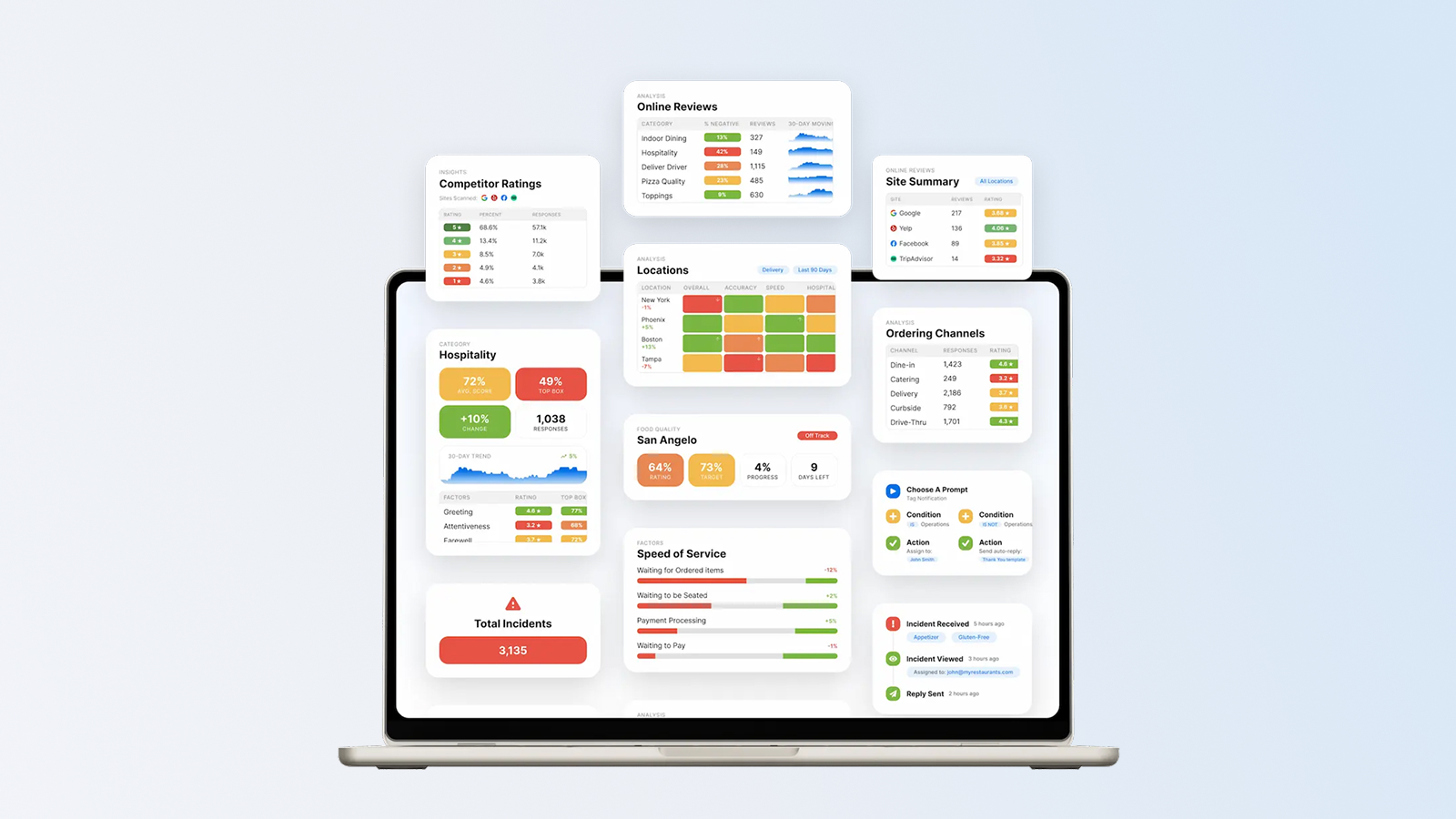
Tattle is a guest feedback and Customer Experience Improvement platform built specifically for multi-unit restaurant brands. It handles every mechanism covered above from a single platform: automated feedback collection across all ordering channels, AI-powered operational coaching at the location level, a centralized guest recovery workflow, and a review management hub that consolidates 15-plus public platforms.
Over 250 restaurant brands use Tattle across more than 15.8 billion data points collected to date. Direct integrations with 35-plus POS, loyalty, and ordering systems (including Toast, Olo, Punchh, Square, Paytronix, and Thanx) mean setup is fast and feedback is tied to real transaction data from day one.
The brands seeing the strongest revenue impact are the ones using Tattle across the full loop: collecting feedback at the factor level, using Monthly Objectives to focus GM coaching, running structured recovery on every negative incident, and prompting satisfied guests toward public review platforms. Each lever reinforces the others.
Want to see how it works for your brand? Watch a Tattle demo here.
Guest feedback drives restaurant sales through several compounding channels: it reduces churn by surfacing operational problems before guests stop returning; it enables direct recovery of dissatisfied guests who would otherwise leave permanently; it increases repeat visit frequency by improving the consistency of the guest experience; it generates more online reviews that attract new guests; and it powers operational coaching that raises satisfaction scores at the location level. The brands that run every one of these channels systematically see the strongest same-store sales growth.
Guest recovery is the process of identifying guests who had a negative experience, reaching them with a personal response within hours of the incident, and offering a resolution or incentive to return. The window is narrow: a timely, genuine response recovers roughly 1 in 3 unhappy guests. A delayed or generic one rarely does. Effective recovery programs track response time, reply rate, and win-back rate to measure and improve the process over time.
High-satisfaction guests who complete a post-visit survey have already demonstrated a willingness to share their opinion. Adding an optional prompt at the end of the survey, linking them directly to Google, Yelp, or another public platform, converts that willingness into a review at a much higher rate than organic posting behavior.
A Customer Experience Rating (CER) is a composite satisfaction metric used in restaurant feedback programs to track overall guest experience across every operational area, not just a single overall impression score. It aggregates performance across food quality, service speed, accuracy, hospitality, cleanliness, and other relevant dimensions into a single index. For multi-unit operators, CER makes it possible to benchmark locations against each other and the portfolio average using a consistent, standardized measure.
The most effective approach is continuous collection triggered automatically after every transaction, via email or SMS sent roughly 90 minutes after a visit. This produces consistent data volume, keeps feedback timely and accurate, and enables the kind of trend analysis that reveals operational problems early. Brands using transaction-triggered surveys with POS or ordering platform integrations typically see participation rates around 10% of transaction volume, which is high relative to industry norms.
Yes, and they are especially valuable for delivery because the guest experience in that channel is harder to monitor through any other means. Kitchen teams rarely get direct visibility into what happens between the restaurant and the guest's door. Feedback programs with integrations into online ordering platforms can collect delivery-specific survey responses and surface issues related to temperature, accuracy, or packaging that would otherwise be invisible to operators.