Insights & Updates
Latest from Tattle
Discover trends, tips, and insights to elevate your restaurant operations.
Discover trends, tips, and insights to elevate your restaurant operations.
 The Tattle Team
TL;DR: Paid acquisition costs for restaurants have risen steeply, with fast casual brands now spending $83–$125 to acquire a single new guest. A 5% improvement in guest retention, driven by a structured restaurant guest feedback platform, can increase profits by 25% or more, while eliminating the need to replace churned guests through paid channels. For a 50-location brand, the combined annual advantage typically exceeds $1 million.
Every CFO and CMO at a multi-unit restaurant brand is asking the same question right now: are we spending our growth dollars in the right place?
The math on paid acquisition is deteriorating fast. Meta's cost per lead rose roughly 21% in 2025, even as conversion rates dropped. Google Ads cost per lead climbed to $70.11, according to WordStream's analysis of over 16,000 campaigns. For restaurants, paid customer acquisition cost now ranges from $27 for quick service brands to $83–$125 for fast casual and casual dining concepts, and nearly $180 for fine dining.
According to SimplicityDX research, customer acquisition costs surged 222% between 2013 and 2022 alone. There is no credible forecast suggesting that trajectory has reversed.
Meanwhile, the guests you already have — the ones who know your brand, trust your product, and return on their own — are sitting largely unmeasured and underinvested.
That gap is what a dedicated restaurant guest feedback platform is built to close.
Harvard Business Review has reported that increasing customer retention by just 5% can increase profits by 25% to 95%. It also costs five to twenty-five times more to acquire a new customer than to keep an existing one.
Three forces explain why retained guests are so much more profitable than newly acquired ones.
Retained guests spend more over time. A returning guest doesn't need to be re-educated about your menu or incentivized with a discount to return. Bain & Company research on repeat customer behavior shows that in categories with frequent purchases, loyal customers spend 67% more in months 31–36 of a shopping relationship than in months 0–6.
The cost to serve them falls. Engaging an existing guest through owned channels, such as a feedback loop, a personalized recovery outreach after a subpar visit, costs a fraction of a paid impression. The probability of converting an existing customer is 60–70%, compared to just 5–20% for a new prospect.
Retained guests fuel organic acquisition. Referred customers carry 16% higher lifetime value than non-referred ones (Wharton School of Business), and industry data consistently shows they are significantly more likely to refer others in turn, creating a compounding flywheel that no ad budget manufactures on its own.
The table below models what a 5% guest retention improvement is worth for a representative 50-location fast casual brand, and what it would cost to replace those same guests through paid acquisition instead.

Assumptions: 50 locations, 500 active guests/location/month, $18 avg. ticket, 8 visits/year, $65 paid CAC, 15% margin. Based on Bain & Company retention research and 2025 industry CAC benchmarks.
For a brand at this scale, the combined annual advantage, which is profit lift plus avoided acquisition spend, exceeds $1.2 million. That number scales directly with portfolio size.
If the retention math is this clear, why do so many operators keep pouring budget into acquisition?
Because acquisition is easy to measure and retention has historically been hard to act on.
Impression counts and new guest totals land neatly in a dashboard. The business value of resolving a complaint about order accuracy, or catching a location that consistently underperforms on speed of service,is far more diffuse, until you aggregate it across a portfolio and attach a dollar figure to it.
Investing in restaurant guest feedback infrastructure is a financial decision, not a soft one. When the right guest feedback platform captures why guests are leaving, not just that they left, multi-unit operators can intervene before churn compounds across dozens or hundreds of locations.
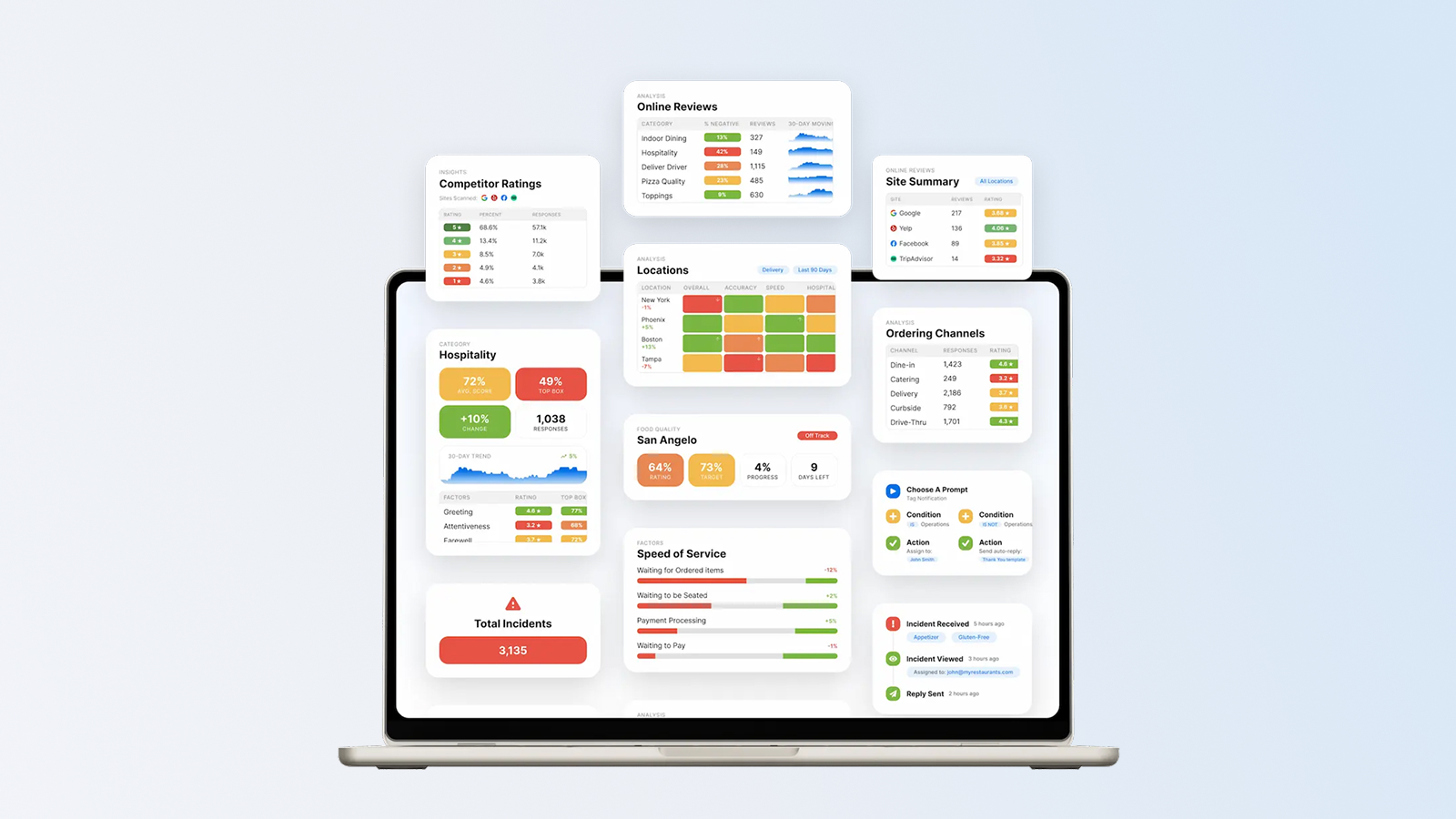
Tattle's restaurant guest feedback platform is built around four operational levers that produce measurable retention outcomes at scale.
Causal feedback collection. Star ratings tell you a guest was unhappy. Tattle's survey methodology identifies exactly why — speed of service, order accuracy, atmosphere, staff interaction. That specificity is what allows operators to fix the right problem, not just the loudest one.
Location-level benchmarking. A retention problem at one location is manageable. The same problem undetected across fifteen locations becomes a brand problem. A centralized restaurant guest feedback platform surfaces systemic issues before they spread.
Automated guest recovery. Recovery outreach triggered within hours of a negative visit meaningfully improves the likelihood of retaining that guest. Tattle automates this loop across every location, without requiring a dedicated marketing team at each one.
GM accountability tools. The general manager is the highest-leverage person in any multi-unit brand's retention equation. Real-time guest feedback data tied to operational scorecards creates the accountability structure that makes retention gains durable, not one-time.
Not all guest feedback tools are equal. Multi-unit operators should evaluate platforms on five criteria.
Causal data collection: Does the platform identify why guests are dissatisfied, or only that they are?
Survey completion rates: Low-friction, mobile-first surveys produce higher response volumes and more statistically reliable data.
Portfolio-level visibility: Can leadership see performance patterns across all locations, not just individual reviews?
Recovery automation: Does the platform trigger guest outreach automatically, or require manual action from location managers?
Operational integration: Can feedback data be tied to training workflows, GM scorecards, and operational improvement programs?
Tattle is purpose-built for multi-unit restaurant brands and addresses all five. It is designed to turn guest feedback into a measurable retention lever, not just a reputation management tool.
What is a restaurant guest feedback platform? A restaurant guest feedback platform is software that collects, aggregates, and analyzes feedback from dining guests across one or more locations. Advanced platforms like Tattle go beyond star ratings to capture operational insights — identifying the specific service, food, or experience factors driving satisfaction or dissatisfaction.
How does guest feedback improve restaurant retention? When operators know exactly why guests are leaving — and can trigger recovery outreach before those guests churn — retention rates improve. Tattle's platform connects feedback data to automated recovery workflows and GM accountability tools, closing the gap between a subpar guest experience and an operational fix.
How much does poor guest retention cost a restaurant? At a 60% retention rate, a 50-location brand with 500 active guests per location and an $18 average ticket loses roughly $12.9M in potential annual revenue to churn — revenue that would need to be replaced through costly paid acquisition. A 5% retention improvement eliminates the need to spend approximately $975,000 in paid CAC to replace those lost guests.
What is the ROI of a restaurant guest feedback platform? ROI comes from two sources: the direct profit lift from retaining more guests, and the acquisition spend avoided by not having to replace churned guests through paid channels. For a 50-location fast casual brand using Tattle's benchmarks, the combined annual advantage exceeds $1.2 million.
How is Tattle different from other restaurant feedback tools? Tattle is purpose-built for multi-unit restaurant operators, with causal survey methodology, portfolio-level analytics, automated guest recovery, and GM accountability tools. Unlike generic review aggregators, Tattle connects guest feedback directly to operational improvements that drive retention at scale.
You are already paying to acquire guests. The question is whether you are protecting that investment after the guest walks in the door — or paying to acquire the same guest twice.
The brands that will win on unit economics in 2026 are the ones that treat restaurant guest feedback as a hard financial lever — modeled, tracked, and optimized with the same discipline applied to food cost and labor.
When you invest in a restaurant guest feedback platform that produces causal, actionable data at the location level, you reduce dependence on paid acquisition, increase the lifetime value of every existing guest, and build the brand loyalty that no ad budget manufactures on its own.
Ready to see what a 5% retention lift is worth for your brand? Book a demo with Tattle →