Insights & Updates
Latest from Tattle
Discover trends, tips, and insights to elevate your restaurant operations.
Discover trends, tips, and insights to elevate your restaurant operations.
 Alex Beltrani
Item-level guest feedback is a method of collecting and analyzing post-visit survey data that attributes guest satisfaction scores to specific menu items and their individual attributes, such as Taste, Texture, Portion Size, Temperature, Presentation, and Value. Unlike overall CSAT scores, item-level feedback tells restaurant operators exactly which item is underperforming and precisely why.
This capability sits at the core of modern restaurant menu optimization strategies and is increasingly used by Culinary Directors, CMOs, and multi-unit operators to guide LTO development, menu engineering decisions, and franchise operational improvements.
Classic menu engineering was built on two variables: sales volume and profitability. Plot your items on a matrix, identify your stars and dogs, and adjust accordingly.
The methodology was introduced in 1982 by Michael L. Kasavana and Donald I. Smith at Michigan State University's School of Hospitality Business, and it was a genuine breakthrough for the industry. However, more than four decades later, it is not enough on its own.
Sales data tells you what happened. It cannot tell you why a guest stopped ordering your smoked brisket flatbread, or why your new summer LTO is generating repeat visit rates that trail the rest of your menu despite strong opening-week numbers.
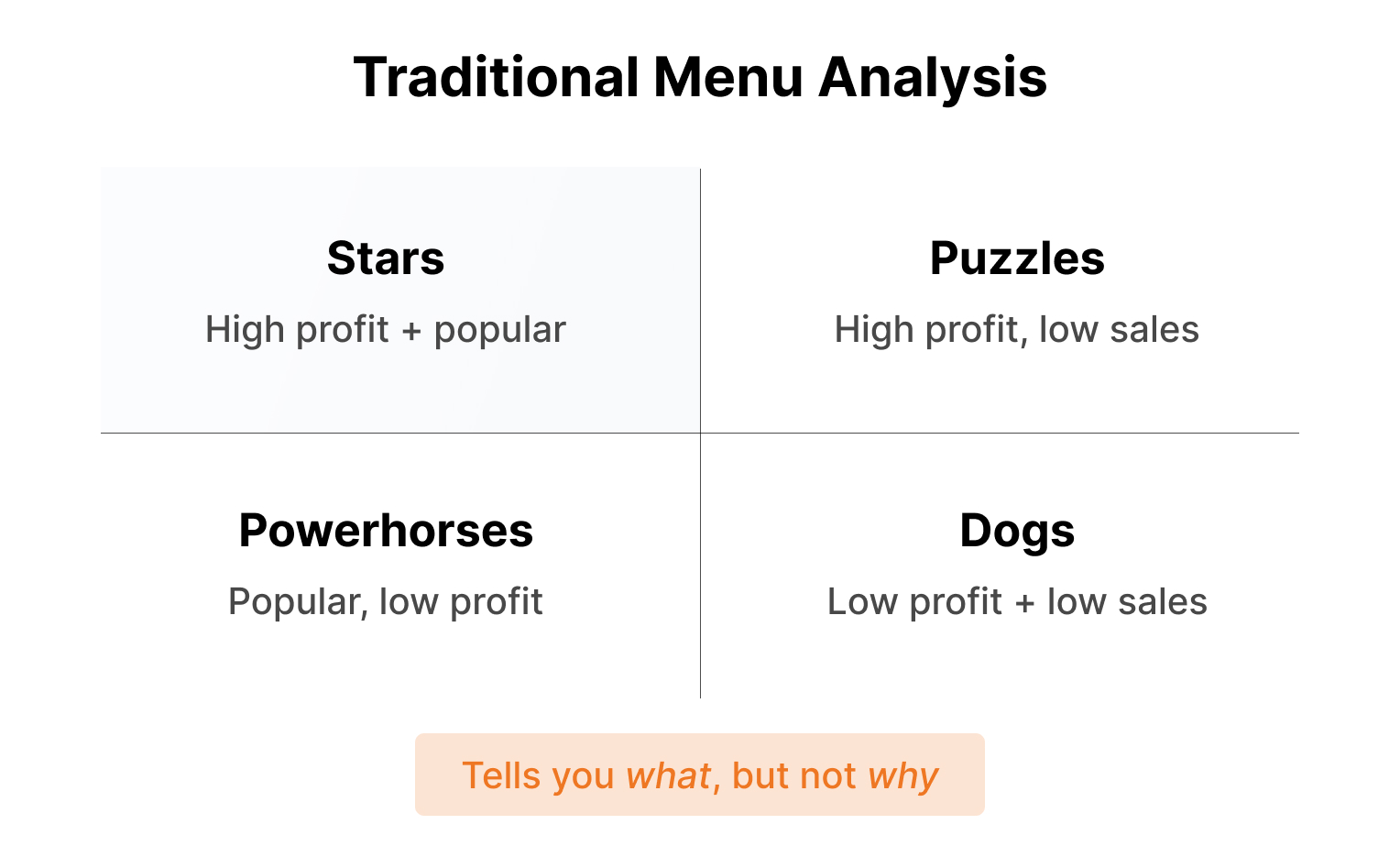
That gap between performance signal and operational insight is where most culinary teams and CMOs are making expensive decisions without adequate information.
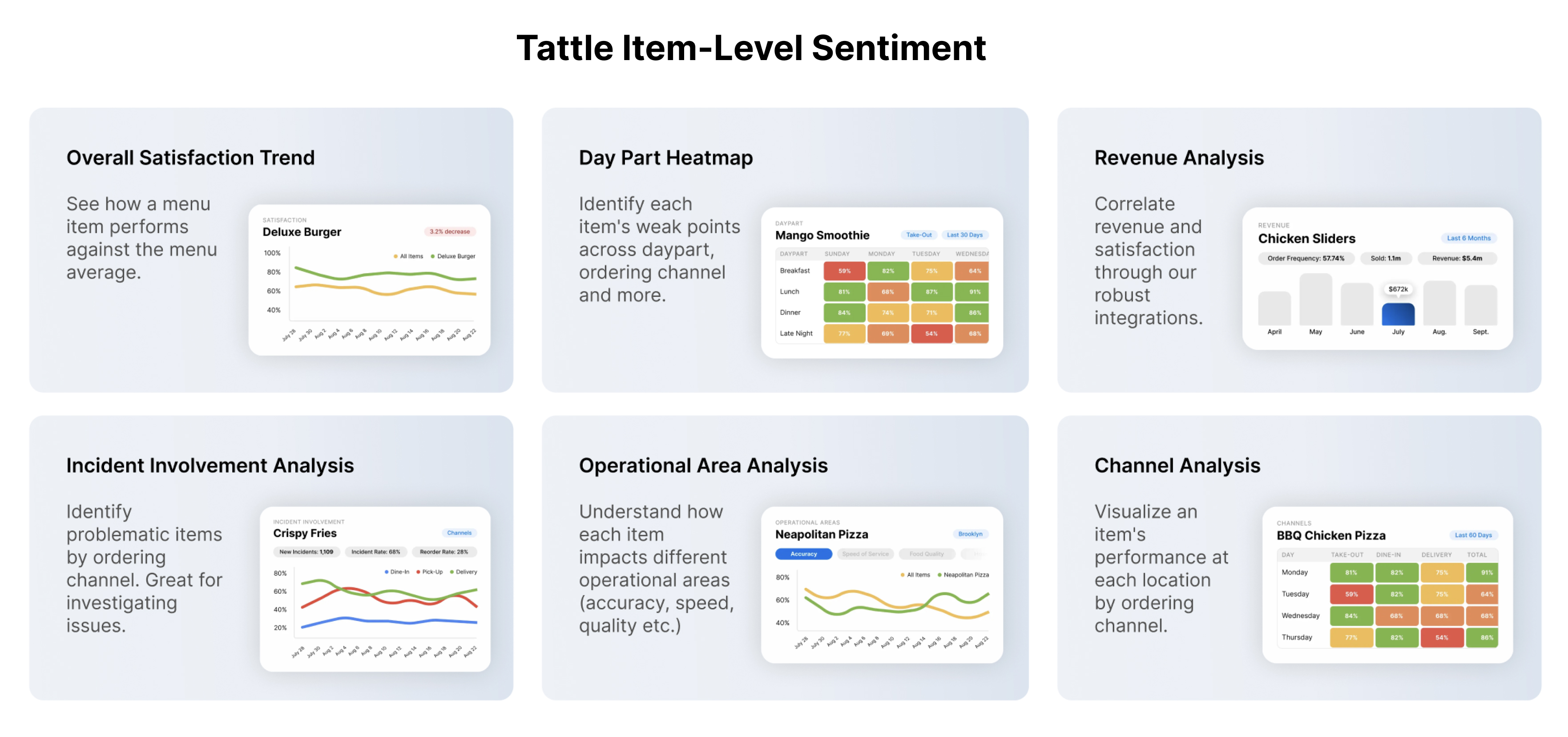
When a guest completes a post-visit survey through Tattle's platform, they are not just scoring the overall experience. They are attributing their satisfaction or dissatisfaction to specific causal categories tied to specific menu items.
The result is a feedback layer that maps directly to your menu, surfacing attribute-level scores for every item across your entire location portfolio.
Consider this scenario: your grilled salmon entrée holds a 71% overall satisfaction score. On the surface, that looks like a menu problem. But the item-level breakdown shows Texture scoring 52% while Taste scores 88%. That is not a recipe issue. That is an execution issue rooted in line-level training or hold time procedures.
That single distinction changes everything about how a culinary director or operations team responds.
A Taste problem sends you back to the test kitchen.
A Texture problem sends you to your franchise operations team.
A Portion Size complaint sends you to your cost-of-goods model.
Without item-level data, most brands treat all three the same way, which typically means expensive R&D cycles chasing problems that were never about the recipe in the first place.
The most common and costly mistake in LTO management is discontinuing an item before understanding what actually drove dissatisfaction. A low overall score concentrated in Portion Size perceptions is a fundamentally different problem than one concentrated in Taste. The former may require only a pricing or plating adjustment. The latter requires a formulation conversation.
Tattle's item-level feedback infrastructure enables culinary teams to make that distinction before pulling an item. Saving an LTO that could have been corrected with a small operational change preserves development investment, reduces menu calendar disruption, and protects the brand equity that an early-stage promotion has already built.
Not every high-satisfaction item is a top seller. Some menu items generate disproportionately strong guest satisfaction scores relative to their order volume, signaling strong brand equity that has not yet been activated through marketing or placement.
Item-level feedback reveals which attribute combinations are driving that satisfaction, giving CMOs and marketing teams the language they need to promote the item authentically and effectively. Guests who call out "perfectly crispy" or "generously portioned" are providing the copy brief for the next promotional push.
The most forward-looking operators are not using feedback only to evaluate items that are already live. They are feeding attribute-level satisfaction data into their culinary development process before a new item reaches the test kitchen.
By analyzing which attribute combinations correlate most strongly with high repeat visit intent across the existing menu, culinary teams can construct a data-backed profile of what a winning LTO looks like. That is the shift from menu engineering to menu intelligence, and it fundamentally changes the economics of LTO development.
LTO development carries real financial stakes. According to research by Datassential, LTOs can boost restaurant sales by up to 20% when they land well, and 81% of consumers say they are more likely to visit a restaurant during an LTO period. But the inverse is also true: a poorly executed or prematurely discontinued LTO wastes the sourcing, testing, training, and marketing investment behind it. The per-decision cost of relying on guesswork versus structured guest feedback data is significant.
Tattle customers using item-level sentiment analysis report faster identification of underperforming attributes, reduced unnecessary reformulation cycles, and more targeted operational coaching at the location level. The ROI compounds across every LTO in the pipeline.
Overall CSAT (Customer Satisfaction Score) measures a guest's satisfaction with the visit as a whole. It is useful for benchmarking and trend monitoring but offers no diagnostic value at the menu level.
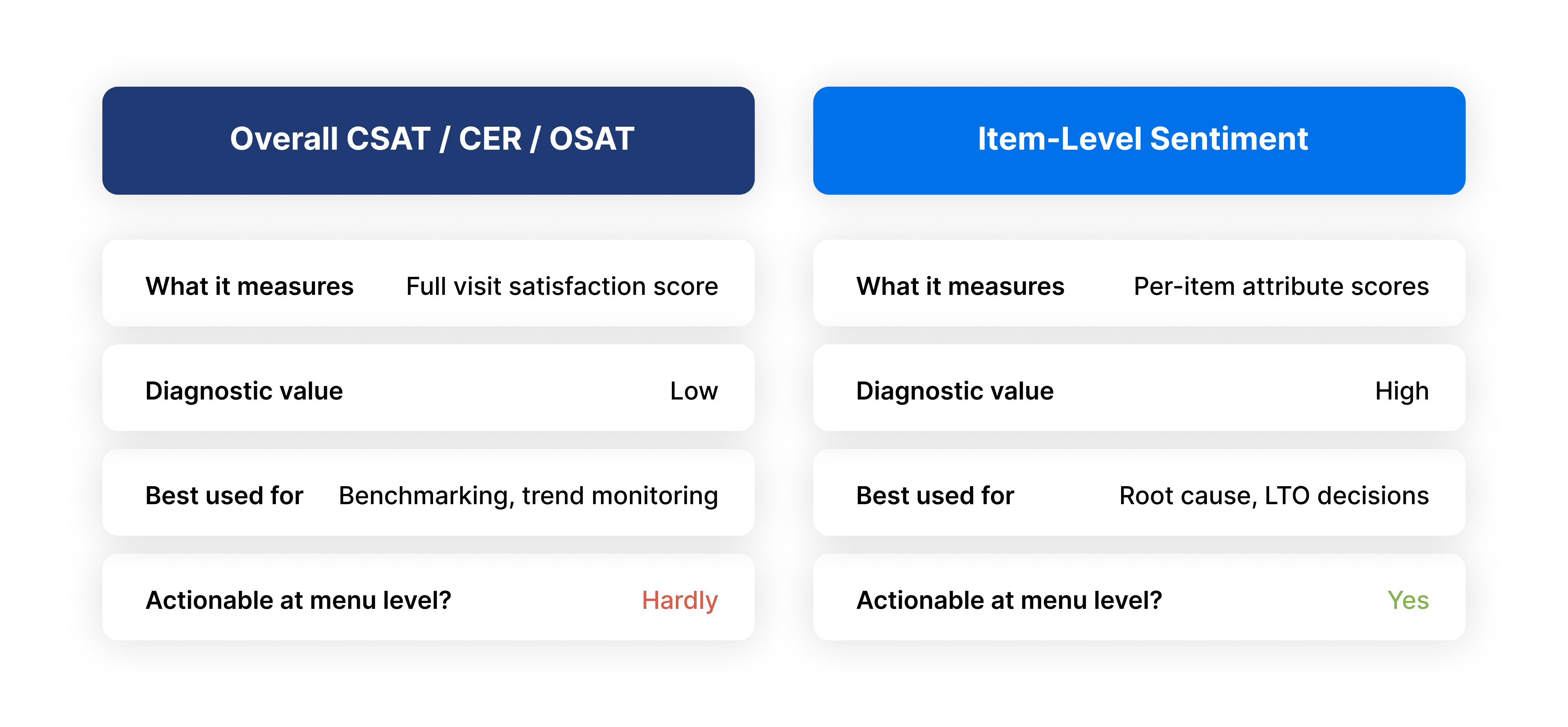
Item-level feedback goes further by isolating the specific menu items a guest ordered and then attributing their satisfaction to individual item attributes. This makes item-level feedback the more actionable metric for culinary directors, menu engineers, and franchise operations teams focused on improving specific underperforming SKUs.
What is item-level sentiment analysis for restaurants? Item-level sentiment analysis is a feedback methodology that captures guest satisfaction scores for individual menu items and their specific attributes, such as taste, texture, portion size, temperature, and value. It goes beyond overall ratings to surface the root cause of menu performance issues.
How do restaurants use guest feedback to improve their menu? Restaurants use post-visit survey data tied to specific menu items to identify which attributes are driving satisfaction or dissatisfaction. This data is used to guide reformulation decisions, operational coaching, pricing adjustments, and LTO development priorities.
What is LTO performance tracking? LTO performance tracking is the process of measuring how a limited-time offer performs across satisfaction metrics, repeat visit intent, and attribute-level guest feedback during its active promotional window. Item-level data allows operators to distinguish between a recipe problem and an execution problem quickly enough to course-correct before the LTO cycle ends.
How is menu engineering different from menu intelligence? Traditional menu engineering uses sales volume and profitability data to classify items. Menu intelligence layers in guest satisfaction data at the item and attribute level, enabling culinary teams to understand not just which items are performing but why, and to make predictive decisions about future menu development.
Which restaurant operators benefit most from item-level feedback? Multi-unit operators, franchise groups, and restaurant brands running active LTO programs benefit most from item-level feedback because the data scales across their entire location portfolio, enabling benchmarking, regional comparison, and attribute-level coaching at scale.
Tattle's platform captures structured post-visit feedback that isolates individual menu items and their guest-reported attributes across every location in a restaurant's portfolio. Operators gain visibility into how each item is landing across taste, texture, portion, temperature, presentation, and value simultaneously, without requiring manual aggregation or cross-platform data reconciliation.
For Culinary Directors managing quarterly LTO calendars and CMOs overseeing system-wide menu strategy, that level of item-level granularity means decisions get made on the basis of what guests are actually experiencing, not on internal hypotheses or lagging sales reports.
Your next limited-time offer should not be decided by committee intuition or historical sales patterns alone. It should be informed by what guests have already told you about every item currently on your menu, broken down by the attributes that drive satisfaction and repeat visits.
The data exists. Item-level guest feedback tools like Tattle make it actionable at scale. The question is whether your LTO development process is using it.
Want to see how Tattle's item-level feedback platform can improve your menu optimization and LTO strategy? Schedule a demo with the Tattle team and see how leading restaurant brands are making smarter menu decisions with guest data.