Insights & Updates
Latest from Tattle
Discover trends, tips, and insights to elevate your restaurant operations.
Discover trends, tips, and insights to elevate your restaurant operations.


I hear it almost weekly: "If only 3% of my guests are leaving feedback, how can that possibly represent my entire customer base?"
It's a fair question. The skepticism that somehow we're only hearing from the loudest complainers, is one of the biggest barriers preventing restaurant operators from unlocking the predictive power sitting right in front of them.
After running revenue correlation analyses across many restaurant brands, from 40-location regionals to national chains with hundreds of units, I can tell you with complete confidence: 3% is not only enough. It's statistically robust.
Let me show you why.
Here's what most operators don't realize: when you're running a restaurant brand, you're dealing with massive transaction volumes. A single location might process hundreds of transactions per day. Across a brand, that's thousands—sometimes tens of thousands—of guest interactions occurring daily.
Over a three to twelve-month period (the typical window we use for revenue correlation analysis), even 3% of that volume represents an enormously healthy sample size. We're often looking at tens of thousands of individual data points.
Think about it this way: political polls that predict national elections with remarkable accuracy typically survey just 1,000-1,500 people out of a population of 150+ million voters. That's 0.0001% of the population. Your 3% feedback rate is comparatively massive.
“Why should I care about whether those 3% of my guests are happy or not?”
Because statistically, their satisfaction speaks volume about your revenue growth.
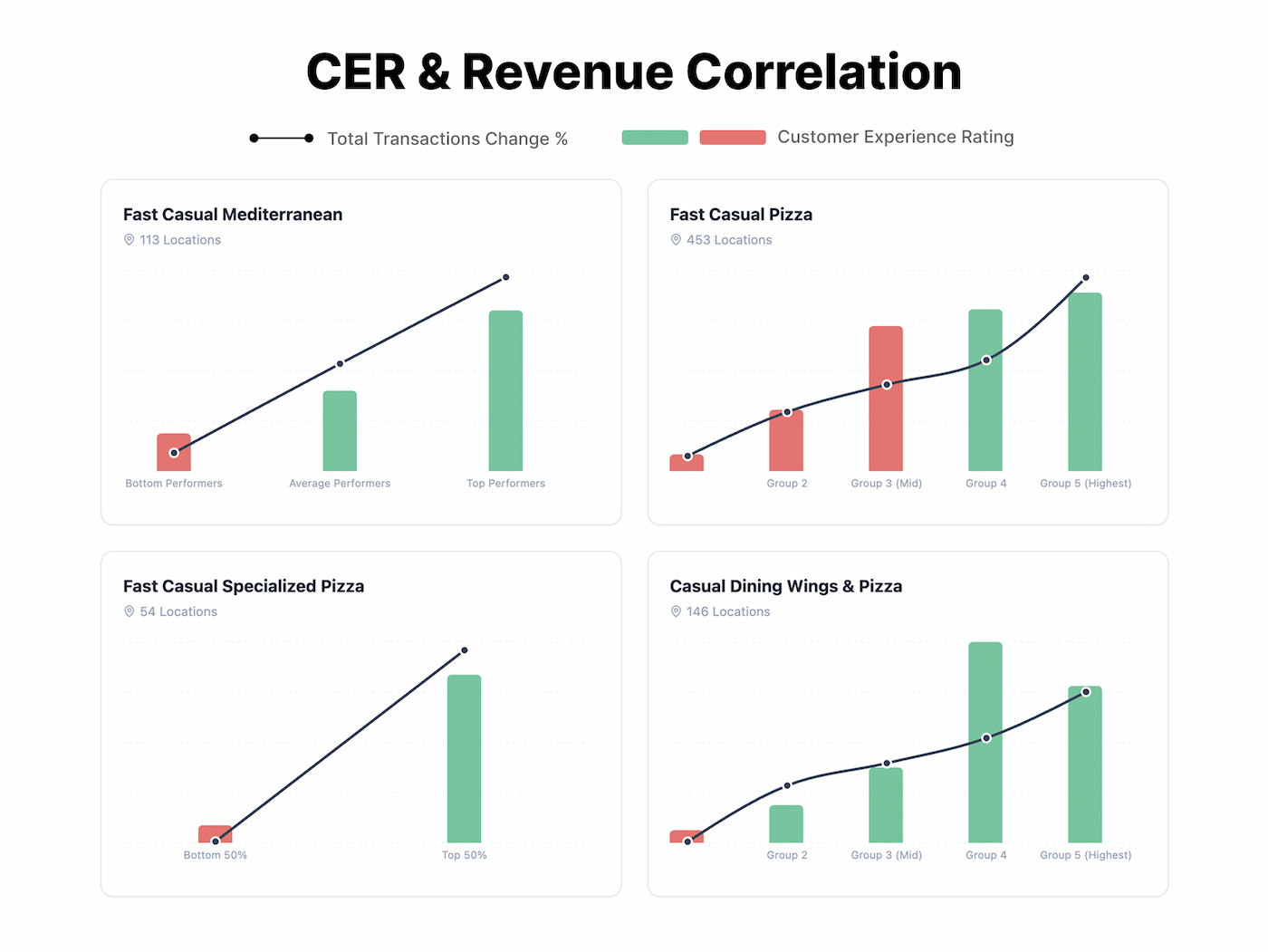
When we group restaurants by quartile (or half, depending on brand size) based on their Customer Experience Rating (CER) or equivalent experiential metric. Then we compare transaction count growth across those groups.
The pattern is remarkably consistent: restaurants in the top quartile for guest experience consistently outperform the bottom quartile in transaction comp growth. And we can measure the gap.
A 4% improvement in CER might equate to 2-3% transaction count growth. It’s measurable, repeatable, and predictive. This pattern holds regardless of the brand size, service mode (e.g. QSR, Fast Casual), food type and geographic location. It simply illustrates the core truth of the hospitality industry: when you keep your guests happy, your business grows.
One thing to note is that these correlations work best within a single brand.
Why? Because when you stay intrabrand, you normalize most variables. Every location has the same menu, the same operational model, the same labor guidance, the same brand standards. However, the execution at each location is different, and that drives experiential variation, which then drives comp growth variation.
Now, about those complainers.
Yes, guests with negative experiences are more motivated to leave feedback. But here's what the data actually shows: across every feedback program I've analyzed, 70-80% of responses are positive.
So no, you're not running a complaint hotline with your surveys. You're capturing a representative cross-section of your guest experience: the good, the bad, and everything in between.
The real value of that negative 20-30%? It gives you actionable recovery opportunities. Those guests are handing you a roadmap to win them back, restart their loyalty cycle, and drive the three repeat visits that turn a one-time visitor into a sustained revenue contributor.
To ensure statistical validity, we build safeguards into every analysis:
Volume thresholds matter. We require a minimum of 30 surveys per month per location to include that restaurant in correlation analysis. This filters out outliers where one or two surveys could skew results wildly.
Time periods are flexible. Depending on the brand's transaction volume and feedback collection rate, we'll adjust our lookback window anywhere from one month to twelve months. The goal is always the same: ensure we have enough data to make the correlation meaningful.
Location count matters too. For smaller brands (say, 40 locations), breaking performance into quartiles means just 10 restaurants per bucket. One high-performing or low-performing outlier can dramatically skew results. In those cases, we cut the brand in half instead: top 50% vs. bottom 50%. Larger samples always produce stronger correlations.
The model only includes comparable restaurants: locations that had transactions both this year and last year, while also meeting the survey volume threshold. If a location doesn't meet those criteria, it's excluded. We're comparing apples to apples.
3% of your guests leaving feedback is not a limitation. It's a statistically robust sample that predicts revenue performance with remarkable consistency.
The guests who take the time to share their experience—whether positive or negative—are giving you a window into what's working and what's not across your entire operation. They're not outliers. They're representatives.
And when you act on what they're telling you? The revenue follows.
Want to see how your guest experience scores correlate with revenue growth? Let's talk about running a custom analysis for your brand.
About the Author
Intelligence & Analytics Expert
Alex formerly led Customer Excellence programs at Blaze Pizza and Dunkin'. Now, he oversees LTO testing, operational analysis, and ROI optimization for Tattle partners.