Insights & Updates
Latest from Tattle
Discover trends, tips, and insights to elevate your restaurant operations.
Discover trends, tips, and insights to elevate your restaurant operations.
 The Tattle Team
Guest satisfaction is not a soft metric. According to Bain and Company, a 5% increase in customer retention can boost profits by 25 to 95%. And research consistently shows that 65 to 80% of restaurant sales come from repeat guests. If you want to improve customer satisfaction in your restaurant, you are working on one of the highest-leverage levers in your entire business.
This guide covers 12 actionable strategies, each grounded in research, that operators and multi-unit leaders can put to work immediately.
In this guide:
- What restaurant customer satisfaction actually means (and how to measure it)
- Why the business case for satisfaction improvement is stronger than ever
- 12 strategies with clear, one-line actions for each
- How leading multi-unit brands use technology to operationalize these plays
- FAQ covering the most common operator questions
Restaurant customer satisfaction is a guest's overall assessment of their experience compared to what they expected. It is not a single number. It is shaped by food quality, service speed, staff attitude, order accuracy, environment, and how well the restaurant responds when something goes wrong.
The American Customer Satisfaction Index (ACSI) 2026 Restaurant and Food Delivery Study places full-service restaurants at an average score of 82 out of 100 and quick-service restaurants at 79. These headline figures mask wide variation between top-performing brands and the rest. The gap between a score of 79 and a score of 84 (where Jersey Mike's sits at the top of the QSR category in 2026) translates directly into measurable differences in repeat visit rates, review ratings, and revenue.
The numbers are consistent across multiple research bodies:
Satisfaction improvement, in other words, is not a customer-service project. It is a revenue project.
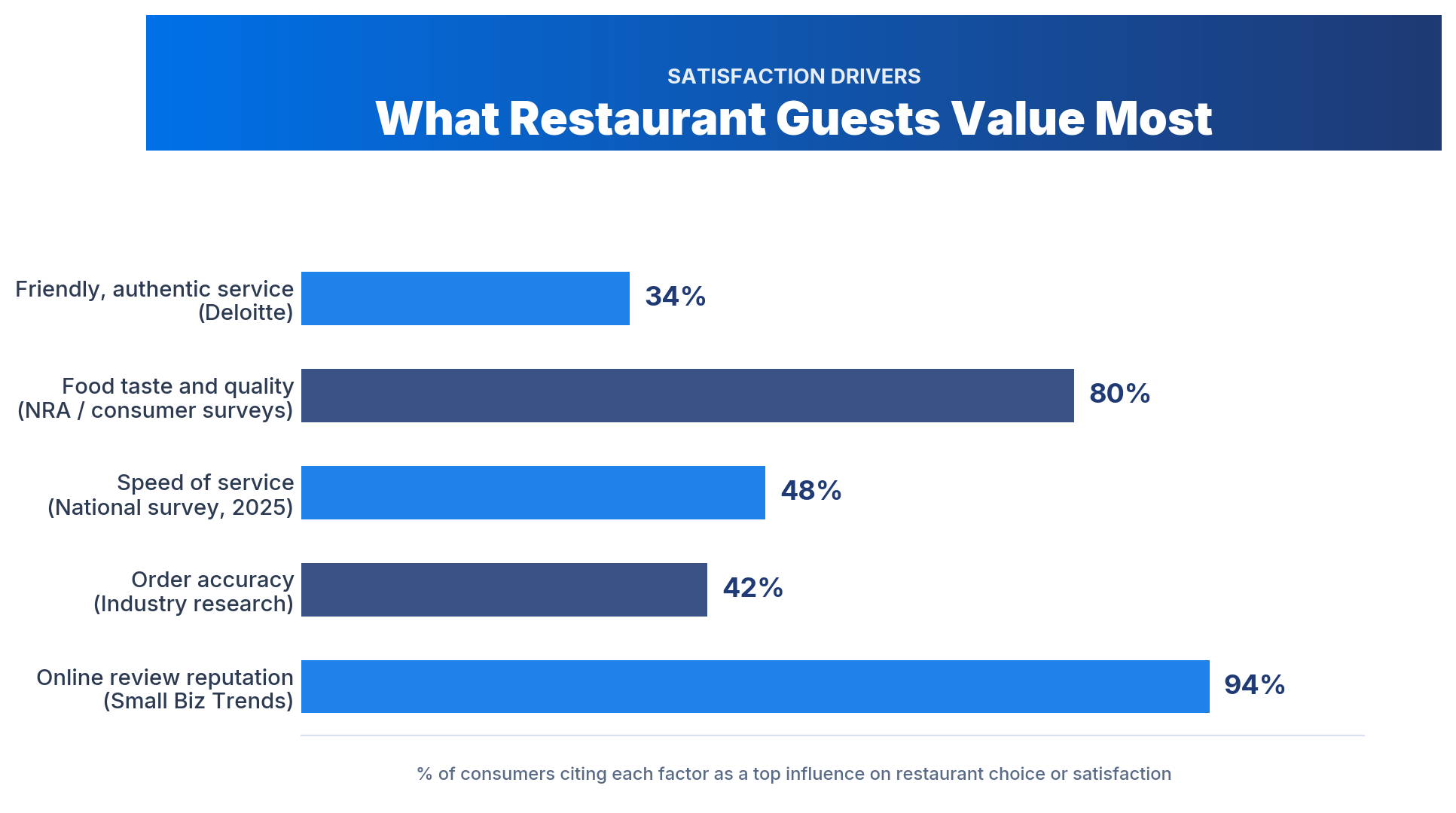
The most common satisfaction driver in consumer research is food quality. Across surveys, approximately 80% of diners cite taste and flavor as a primary factor in their restaurant choice. The problem most operators face is not that their food is bad on its best day. The problem is inconsistency: the same dish varying by shift, location, or team member.
One-line action: Standardize recipes, portioning, and plating at the location level, then measure guest feedback on food quality by time of day and shift to spot where consistency breaks down.
Pay particular attention to your top-selling items. A guest whose favorite dish is right 9 times out of 10 will remember the one time it was wrong.
According to a Deloitte survey on restaurant customer experience, the top element that creates a memorable dining experience is friendly and authentic service, cited by 34% of respondents. Real-time information (22%) and feeling listened to (20%) follow. Technical proficiency matters, but warmth is what guests remember.
One-line action: Build hospitality expectations into onboarding and ongoing coaching with specific, observable behaviors (greeting guests by name, making eye contact, checking back within two minutes of food delivery) rather than generic "be friendly" instructions.
Training that focuses on behaviors rather than attitudes tends to produce more consistent results across shifts and team members.
A 2024 Waitwhile consumer survey found that more than 43% of consumers report feeling less satisfied with businesses that require them to wait in a queue. Research on restaurant-specific waiting found that guests who wait longer than expected report 18% lower satisfaction scores.
One-line action: Set a target time for each service moment (greeting, order, food delivery) by daypart, track against it, and address the specific operational cause when you miss it.
The issue is almost never one thing. It might be kitchen throughput on a specific prep step, a staffing gap during peak periods, or friction in the order-taking process. Measuring which moments are slow tells you where to focus.
An incorrect order is one of the fastest ways to destroy a positive experience. The guest who ordered a burger without onions and received one with onions will often not say anything in the moment. They will simply not come back, and they may leave a negative review that mentions it.
One-line action: Track order accuracy as an explicit metric separate from overall satisfaction. If your feedback system does not surface order accuracy by channel (dine-in, drive-thru, pickup, delivery), build that granularity in.
Delivery orders tend to have higher error rates because they involve more handoffs. If your delivery mix is growing, order accuracy deserves extra attention at the packaging and handoff steps.
Research on service encounters consistently shows that the first 30 to 60 seconds of a visit set the tone for everything that follows. When guests feel seen and welcomed immediately, they tend to be more forgiving of minor issues later in the experience.
One-line action: Set a standard for acknowledgment within the first 30 seconds of a guest entering or reaching the counter, regardless of how busy the location is. A brief, genuine "we'll be right with you" is enough to reset the perceived wait.
This costs nothing and is one of the highest-return behaviors a team can develop.
Informal feedback (Google reviews, social comments) tells you what happened after a guest decided to say something publicly. Structured feedback, collected close to the time of the visit, tells you what actually happened operationally before they made that decision.
One-line action: Collect feedback for every major channel separately (dine-in, drive-thru, takeout, delivery) so you can compare satisfaction scores by channel and identify where the experience differs.
Guest experience varies significantly by how an order is placed and fulfilled. A brand that scores well for dine-in but poorly for delivery has a specific problem to solve, not a general satisfaction problem.
Most operators think about reviews reactively: responding after a negative review goes up. The more effective approach is proactive: encouraging satisfied guests to share their experience close to the time of the visit, and resolving dissatisfied guests' issues before they reach a public platform.
One-line action: Make requesting feedback part of your post-visit process, and train your team to resolve complaints immediately rather than allowing them to leave unresolved.
The FTC's 16 CFR Part 465 regulations prohibit incentivized or fake reviews, as do the policies of Google, Yelp, and TripAdvisor. Asking guests to share their honest experience is entirely compliant. Offering discounts or free items in exchange for positive reviews is not.
A Harvard Business School study found that even a half-star improvement on Yelp can translate into a meaningful revenue bump, particularly for mid-tier restaurants competing on reputation in a dense market.
94% of diners read reviews before choosing a restaurant. Almost as many read the restaurant's responses. A thoughtful, specific reply to a negative review signals to potential guests that this is a brand that takes problems seriously.
One-line action: Establish a response SLA (service-level agreement): all reviews responded to within 24 hours, with a specific acknowledgment of the guest's actual concern, not a generic apology.
Generic responses ("We're sorry you had a bad experience, please contact us") perform worse than specific ones. Reference what the guest mentioned and, where possible, describe what you are doing about it.
When a guest has a bad experience and the restaurant resolves it well, they often end up more loyal than guests who had no problem at all. This is the Service Recovery Paradox, and it is well documented in hospitality research. The catch is that recovery has to be fast: a guest who gets a call two weeks after a complaint is not going to feel recovered.
One-line action: Build a process for flagging and contacting unhappy guests within 24 hours of their visit, with a clear resolution protocol (apology, acknowledgment, specific make-good offer where appropriate).
The key word is "process." Recovery that depends on a manager noticing a complaint and deciding to do something about it is inconsistent. Recovery built into an operational workflow, with clear ownership and timing, is not.
Collected feedback that does not result in a defined improvement target tends to create cynicism: guests feel like their input is ignored, and team members wonder why they bother tracking it. Improving satisfaction requires closing the loop between what guests say and what changes at the location level.
One-line action: Translate your lowest-scoring satisfaction areas into specific, measurable improvement goals for each location. Revisit them monthly with the location's leadership.
A broad goal ("improve food quality") is hard to act on. A specific goal ("reduce food quality complaints during the 11am to 1pm daypart by 30% over the next 90 days") gives a team something to measure and a reason to change behavior.
Guests increasingly move between channels. A guest who has a great dine-in experience at your brand will have expectations set when they order delivery. If the delivery experience is significantly worse, their satisfaction with the brand drops even if the dine-in experience remains excellent.
One-line action: Measure and compare satisfaction scores across channels regularly. Where you find significant gaps, trace them to a specific operational cause (packaging, handoff, kitchen accuracy) rather than assuming the channel is inherently harder.
Channel-level data is one of the most useful diagnostics available to multi-unit operators because it isolates problems. A food quality issue that appears across all channels points to a recipe or prep problem. The same issue that appears only in delivery points to packaging or handoff timing.
Satisfaction improvement stalls when managers do not know where to focus. Without data, coaching conversations tend to be vague ("guests seem unhappy about service speed") or reactive (responding to a spike in bad reviews after the damage is done). Data changes that dynamic.
One-line action: Give each location manager a clear view of their satisfaction trends, their lowest-scoring operational areas, and a specific priority to work on each month, derived from guest feedback rather than observation alone.
Multi-unit brands that build this cadence consistently outperform those that manage by exception. The goal is not to generate reports. The goal is to make the right thing for the manager obvious.
Executing these 12 strategies manually, across dozens or hundreds of locations, is where most operators hit a ceiling. The feedback is too fragmented, the reporting too slow, and the coaching too inconsistent to drive systematic improvement at scale.
Tattle is a Customer Experience Improvement (CXI) platform built for multi-unit restaurant brands. It is designed to close the gap between collecting guest feedback and actually improving operations.
A few of the ways it maps to the strategies above:
Causation-based feedback collection (strategies 6 and 11): Tattle's surveys are designed to identify the operational causes of satisfaction and dissatisfaction, not just surface a rating. Feedback is collected separately by channel (dine-in, drive-thru, pickup, delivery), so operators can compare performance across order types and isolate where the experience breaks down.
Guest Recovery (strategies 5 and 9): Tattle's Guest Recovery feature surfaces dissatisfied guests in real time so teams can reach out before those guests write a public review. The goal is to turn a negative experience into a resolved one within the window where recovery is still possible.
AI Coach (strategy 12): Tattle's AI Coach turns each location's feedback data into prioritized, SOP-aligned action items for GMs. Rather than requiring a manager to interpret a report, AI Coach tells them what to work on and why, based on what their guests are actually saying.
Review Management (strategies 7 and 8): Tattle's Review Management feature centralizes online reviews and supports a consistent response workflow across platforms.
If you want to see how these features work together in practice, Tattle's success stories include examples from multi-unit brands that have used guest feedback to drive measurable location-level improvement.
What is the most important factor in restaurant customer satisfaction? Food quality is consistently the top driver: approximately 80% of consumers name taste and flavor as a primary reason for choosing a restaurant. That said, a single great meal does not guarantee a return visit. Consistency across visits is what builds loyalty. Friendly, authentic service is the top factor in whether an experience is memorable, according to Deloitte research.
How do you measure customer satisfaction in a restaurant? Restaurant operators typically combine structured feedback (post-visit surveys, in-app or digital questionnaires tied to a transaction) with public review data (Google, Yelp, TripAdvisor) and operational metrics (order accuracy rates, speed of service times). The most actionable approach is structured feedback collected close to the visit and broken down by channel and operational category, so you can see which specific areas need improvement.
What causes low customer satisfaction in restaurants? The most common causes are inconsistent food quality, slow or inattentive service, incorrect orders, and unresolved complaints. In many cases, the underlying issue is not a front-of-house problem but an operational one: staffing gaps during peak periods, prep issues in the kitchen, or weak onboarding for new team members.
How much does a bad customer experience cost a restaurant? A 78.8% annual guest churn rate costs the average restaurant location an estimated $375,380 per year in lost opportunity, according to Bloom Intelligence data. Beyond that direct cost, each churned guest who leaves a negative review influences future guests' decisions: 94% of diners check reviews before choosing where to eat.
How do you improve customer satisfaction scores quickly? The fastest wins tend to come from acknowledgment and recovery: training staff to greet guests immediately, establishing a process for resolving complaints before guests leave the location, and responding to negative reviews within 24 hours. These changes cost little and show results within weeks. Structural improvements to food consistency and service speed take longer but have more lasting impact.
Is it worth responding to negative restaurant reviews? Yes. Responding to negative reviews signals to potential guests that the restaurant takes feedback seriously. A specific, empathetic response to a negative review often converts a skeptical potential guest into one willing to give the restaurant a try. Generic or defensive responses have the opposite effect.
How does Tattle help restaurants improve customer satisfaction? Tattle is a Customer Experience Improvement platform that collects structured guest feedback across all channels, surfaces unhappy guests in real time for recovery, and gives GMs prioritized action items through its AI Coach feature. The goal is to make it operationally straightforward for multi-unit brands to identify what is hurting satisfaction at each location and take targeted action on it.
What is a good customer satisfaction score for a restaurant? The ACSI 2026 benchmark is 79 for quick-service restaurants and 82 for full-service. Top-performing brands in both categories score 83 to 84. If your internal satisfaction metric (CER, CSAT, OSAT, or a similar score) is consistently below category average, that gap represents actionable improvement opportunity.
Most guest satisfaction problems are operational problems in disguise. A food quality complaint is often a prep consistency problem. A service speed complaint is often a staffing or kitchen workflow problem. A hospitality complaint is often a training and accountability problem.
The operators who improve satisfaction consistently are not the ones who care most about their guests (almost everyone cares). They are the ones who have built systems to find out what is actually going wrong and who is accountable for fixing it.
Start with the strategies that require no new tools: consistent greetings, immediate complaint resolution, and specific monthly improvement goals at each location. Then build the feedback and data infrastructure to scale what you learn.
Request a demo of Tattle's CX platform to see how structured guest feedback can turn into measurable location-level improvement.