Insights & Updates
Latest from Tattle
Discover trends, tips, and insights to elevate your restaurant operations.
Discover trends, tips, and insights to elevate your restaurant operations.
 The Tattle Team
To respond to a negative restaurant review, reply within 24 to 48 hours, thank the guest for the feedback, acknowledge their specific experience, apologize without making excuses, offer to make it right offline, and invite them back. Keep the response short, personal, and free of defensiveness so it reassures the dozens of future diners who will read it.
That sounds simple. In practice, the manager writing the reply is often the same person who just lived through the bad shift, and the temptation to defend the team, correct the facts, or quietly hope the review disappears is strong. This guide breaks the response down into a repeatable process, gives you ready-to-use templates for the most common complaints, and shows what to avoid. Every template is written to be edited in under a minute, because the goal is a fast, human reply, not a perfect essay.
A negative review feels like a problem aimed at you. To the people reading it later, it is research. Prospective guests scanning your listing are not only weighing the complaint, they are watching how the business answers it. A calm, specific, accountable reply often does more to win them over than the original review did to scare them off.
The business case is well documented. Researchers at Harvard Business School found that for independent restaurants, a one-star improvement in Yelp rating was associated with a meaningful increase in revenue, evidence that review reputation maps directly to the top line. Consumer surveys, such as BrightLocal's annual Local Consumer Review Survey, consistently report that a large majority of people read businesses' responses to reviews and that the presence and tone of those responses influences whether they will visit.
There is also an operational payoff that is easy to miss. A review is a guest telling you exactly where your experience broke down, in public, for free. Handled well, the worst review of your week is also the clearest piece of feedback you will get.
Use this sequence for almost any complaint. It works for a one-line gripe and for a detailed takedown.
Respond quickly. Aim for 24 to 48 hours. A fast reply signals that someone is paying attention, and it reaches the guest while the visit is still fresh.
Read it twice and find the real issue. Separate the emotion from the event. “Worst service ever” usually points to one concrete failure: a long wait, a wrong order, a dismissive server. Respond to the event.
Thank them and use a name. Open with genuine thanks for the feedback. Use the guest's name if it is available and sign off with a real name and role, not “Management.”
Acknowledge and apologize, without excuses. Name what went wrong in their words and say you are sorry it happened. Skip “but we were short-staffed.” Reasons read as defenses.
Take it offline. Offer a direct email or phone number and invite them to continue privately. This protects the guest's details, lets you resolve specifics, and keeps the public thread short.
Show what changes. Where it is true, mention the concrete step you are taking. “We have re-briefed the closing team on order checks” shows accountability the next reader will notice.
Invite them back. Close with a sincere invitation to give you another chance. The reply is for them, but the recovery is the return visit.
A shortcut for remembering all these is The 4 A framework: Acknowledge what happened, Apologize for the experience, Act by moving it offline and fixing the cause, and Ask them to come back. If a reply has all four and no excuses, it will hold up.
Copy a template, swap in the guest's name and the specific detail, and post. Replace anything in brackets. Keep your edits short. The brackets are prompts, not a script to read verbatim.
Hi [Name], thank you for letting us know, and I'm sorry the [dish] did not meet the standard you should expect from us. That is not the food we want to send out. I'd like to learn more and make it right. Please reach me directly at [email or phone]. We hope you'll give our kitchen another chance.[Sign with name, role]
Hi [Name], I'm sorry your visit took far longer than it should have. A [wait time] wait is not the pace we aim for and I understand how frustrating that is, especially when you've set time aside to enjoy a meal. I'd like to hear more about that evening and make it up to you. You can reach me at [email or phone].[Sign with name, role]
Hi [Name], thank you for telling us, and I'm sorry you were treated this way. Feeling unwelcome is the opposite of what we want for every guest, and I take it seriously. I'd appreciate the chance to understand what happened and address it with the team. Please contact me directly at [email or phone].[Sign with name, role]
Hi [Name], I'm sorry we got your order wrong. You ordered [item] and that is what you should have received. I'd like to make this right, so please reach me at [email or phone] and I'll take care of it personally. Thank you for the feedback, it helps us tighten up our order checks.[Sign with name, role]
Hi [Name], thank you for raising this, and I'm sorry about what you saw. Cleanliness is not something we compromise on, so this matters to me. I've shared your note with our team and we are reviewing [area] today. I'd welcome the chance to talk further at [email or phone].[Sign with name, role]
Hi [Name], thank you for the honest feedback. I'm sorry the visit didn't feel worth it, because value matters as much to us as it does to you. I'd like to understand what fell short of your expectations. Please reach me at [email or phone], I read these personally.[Sign with name, role]
Hi [Name], thank you for the thoughtful review, and I'm glad the [positive: e.g. service, atmosphere] landed well. You're right about the [issue], and I'm sorry it took the shine off the visit. I'd like to make the next one better, please reach me at [email or phone] so I can follow up.[Sign with name, role]
Hi [Name], I'm sorry to see you had a one-star experience. I'd genuinely like to understand what went wrong so we can fix it. Whenever you have a moment, please reach me directly at [email or phone]. Thank you.[Sign with name, role]
Sometimes a review describes a visit that never happened, names a competitor's location, or crosses into harassment. Handle these in two tracks at once.
Report it. Most platforms let you flag reviews that violate their policies, such as ones with no genuine experience, conflicts of interest, or abusive language. Reporting is your real remedy; the public reply is not.
Reply calmly anyway. Future readers see the review whether or not it is removed, so a measured public response protects your reputation while the report is reviewed.
Hi [Name], thank you for reaching out. We take all feedback seriously, but we don't have a record of this visit and some details here don't match our restaurant. We'd welcome the chance to look into it with you directly at [email or phone]. If this was meant for another business, we understand, and we wish you well.[Sign with name, role]
Never accuse the reviewer of lying in public, even when you are sure. A reader cannot verify the dispute, but they can read your tone, and a composed reply always wins that exchange.
Do not get defensive or argue the facts. Winning the argument loses the audience.
Do not copy and paste the identical reply everywhere. Readers and platforms both notice templated, generic responses. Personalize at least one line.
Do not over-apologize or grovel. One sincere apology is stronger than three.
Do not resolve the whole thing in public. Offer comps, refunds, and specifics privately.
Do not let it sit for two weeks. A late reply reads as an afterthought.
Do not ignore the positive reviews. Thanking happy guests, briefly, signals an engaged, attentive business and balances your public profile.
For a single restaurant, this is a daily habit. For a brand with ten, fifty, or two hundred locations, it becomes an operational discipline. Reviews land across Google, Yelp, delivery apps, and social platforms, on different days, in different tones, with no single inbox. Response times slip, voice drifts location to location, and the recurring complaints, the ones worth fixing at the root, get lost in the volume.
Two things have to work together at scale. First, you need to see and respond to public reviews from one place, so no location goes quiet and the brand voice stays consistent. Second, and this is the part most teams miss, you need to connect what guests say privately to what they post publicly, so the response is not just damage control but the start of a fix.
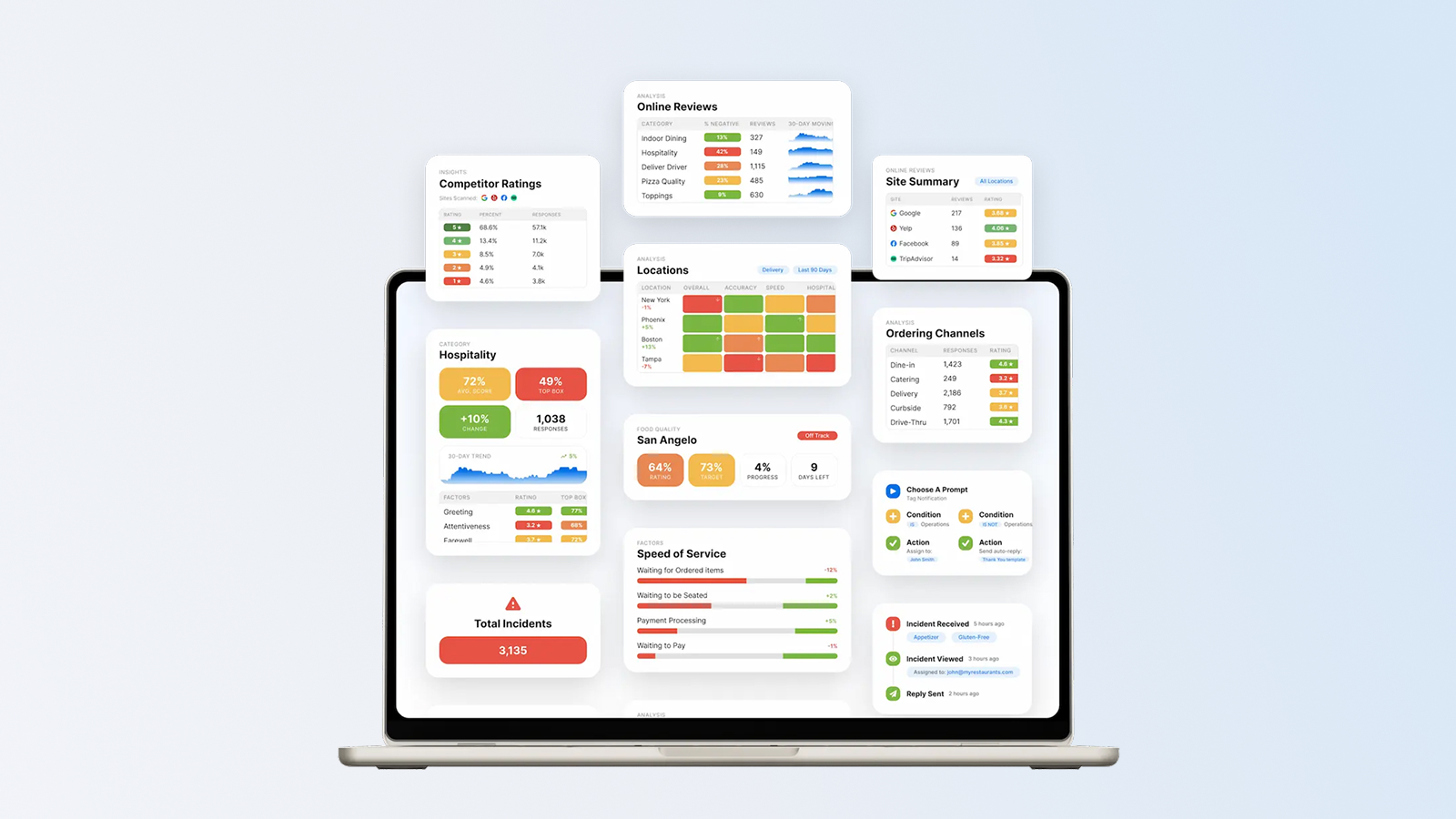
This is where a feedback platform built for restaurants changes the math. Tattle's review management brings reviews across sources into a single view so multi-unit teams can track response rates, monitor sentiment by location, and keep replies timely and on-brand. Its guest recovery tools close the loop with unhappy guests directly, often before frustration ever reaches a public star rating.
What makes that loop more than a faster reply is causation. Rather than only telling you a guest was unhappy, Tattle's causation-based surveys isolate the specific operational driver behind the rating, whether that was order accuracy, speed, friendliness, or cleanliness, so you are not guessing at the root cause across hundreds of reviews. Each location then gets a Monthly Objective: the single improvement, grounded in that data, most likely to lift the guest experience next month. The public reply handles the one guest in front of you. The objective fixes the issue so the next ten guests never have to write the review at all.
Within 24 to 48 hours. A reply in that window reaches the guest while the visit is fresh and signals to future readers that the business is attentive. For high-volume brands, a same-day target for one and two-star reviews is a reasonable internal standard.
Yes, respond to every one and two-star review and to any review that raises a specific complaint. You do not have to reply to every five-star rating with no comment, but an occasional brief thank-you on positive reviews strengthens your public profile.
Report it to the platform for violating their content policies, then post a calm, factual public reply noting that you have no record of the visit and inviting the person to contact you directly. Do not accuse the reviewer of lying in public, since future readers judge your tone more than the disputed facts.
Avoid excuses such as being short-staffed, avoid arguing the facts, avoid resolving refunds or comps in public, and avoid copy-pasted identical replies. A defensive or generic response does more reputational damage than the original review.
Review reputation is closely tied to revenue, and research on restaurant ratings has linked star-rating improvements to higher sales. Thoughtful responses support that by reassuring prospective diners and by surfacing recurring issues you can fix, which protects future ratings.
Either, as long as the reply is signed with a real name and role and the person can actually follow up. For multi-location brands, a designated responder or a shared review management workflow keeps responses timely and consistent in voice across every location.