Insights & Updates
Latest from Tattle
Discover trends, tips, and insights to elevate your restaurant operations.
Discover trends, tips, and insights to elevate your restaurant operations.

When sales at your restaurants stagnate – or even drop – it can be a real head scratcher.
But the answer can be both simple and accessible if your brand has been consistently collecting high-quality, high-velocity guest feedback data after each transaction.
In fact, just by comparing guest satisfaction metrics across all your locations, you can almost guarantee which location will likely see faster or slower sales growth.
Sounds incredible? We’ll break down the data and reporting we did for one of the Tattle partners in this blog.
To protect Tattle partners’ privacy, we’ll call the restaurant brand in this case study “Rapid Pies”.
Rapid Pies’ was having some issues. While their top locations were doing relatively fine, the bottom to mid quintiles were all experiencing negative sales growth.
In other words, sales were dropping.
To help them further investigate the issue, Tattle’s analytics team helped them map out the correlation between their guest satisfaction and sales growth.
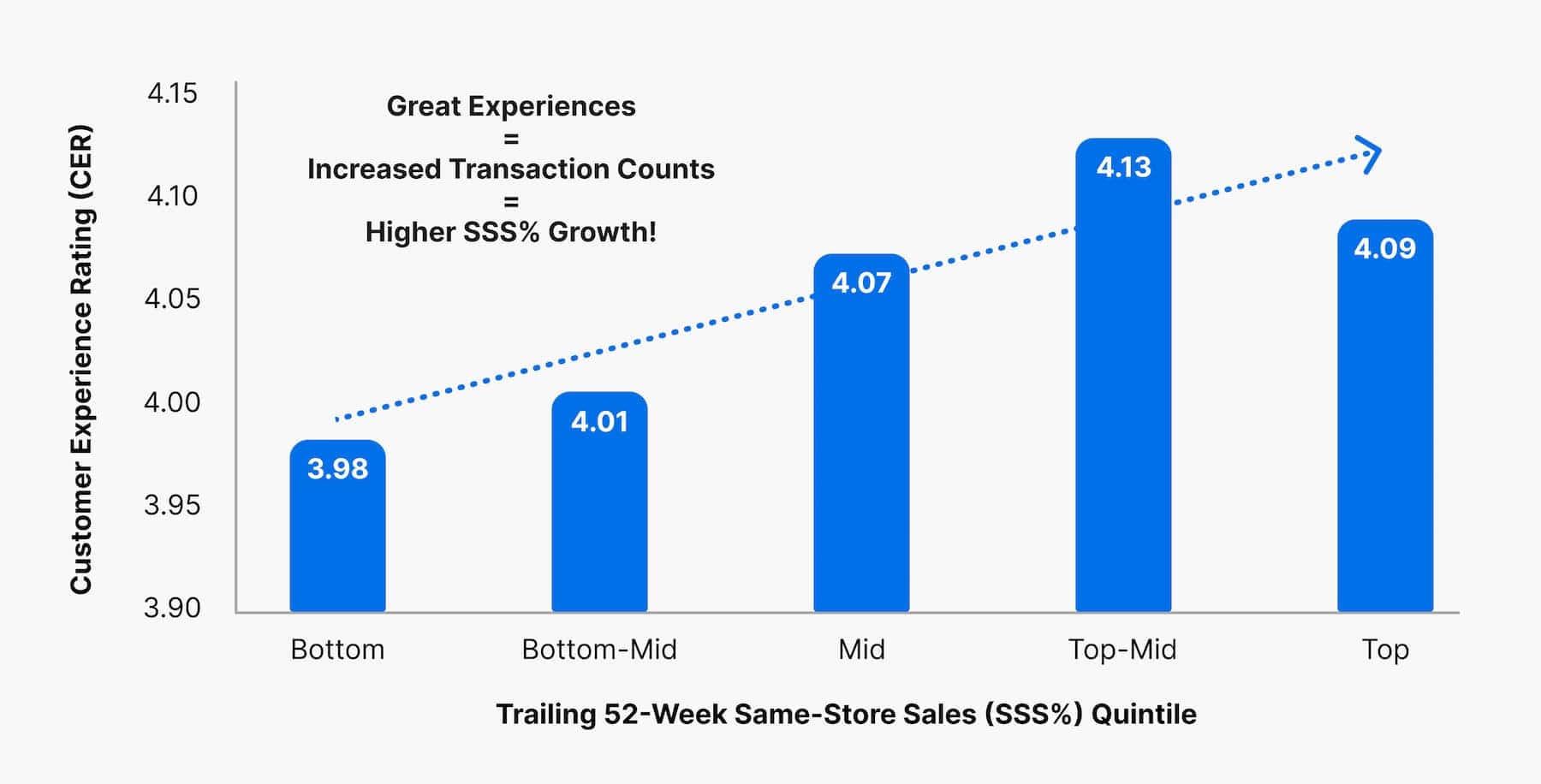
Y-axis: CER (Customer Experience Rating) on a scale of 1 to 5. But other metrics such as NSAT, Top Box etc. will also work.
X-axis: Rapid Pies locations grouped into 5 groups, based on their sales growth. In other words, the top quintile locations have the highest sales growth, while the bottom quintile locations have the lowest (in this case negative) sales growth.
The correlation is very obvious.
Locations in the top group has a lower guest satisfaction measure than the top-mid group, as they tend to have less oversight and be more self-sustaining.
The reason we use sales growth instead of absolute sales numbers is because it normalizes all other external factors such as location, traffic, resources etc. that might give certain locations certain advantages over others. As a result, sales growth is a better metric for benchmarking your locations.
Note: In order to have an accurate reading of sales growth, you’d need the rolling 52-week same-store sales numbers, which means your restaurants need to be open for at least 12 months prior.
What the chart above tells us is that if a location performs better in guest experience compared to its peers, it will see greater sales growth than the rest.
It makes intuitive sense: if I can provide a great guest experience today, it will lead to more repeat customers, more word of mouth, and perhaps even larger ticket sizes.
Sales might not immediately rise when your guest experience improves, as it takes time to win over customers, but it will eventually follow. And that’s why guest experience is a great leading indicator for sales at your restaurants.
We have other blogs dedicated to how you can improve guest experience by (https://get.tattleapp.com/blog/how-to-bridge-operational-gaps-between-different-guest-journeys/) between different guest journeys, (https://get.tattleapp.com/blog/hitting-the-bulls-eye-literally-in-your-restaurant-operations/), (https://get.tattleapp.com/blog/how-to-empower-gms-to-hit-guest-satisfaction-goals-with-tattle/) to better prioritize, and more!
About the Author
Intelligence & Analytics Expert
Alex formerly led Customer Excellence programs at Blaze Pizza and Dunkin'. Now, he oversees LTO testing, operational analysis, and ROI optimization for Tattle partners.