Insights & Updates
Latest from Tattle
Discover trends, tips, and insights to elevate your restaurant operations.
Discover trends, tips, and insights to elevate your restaurant operations.


The executives at a gourmet donut brand are faced with a dilemma.
On the one hand, their famously elaborate donuts are meant to be enjoyed warm. On the other hand, people tend to order donuts for pickup and consume them later.
So here comes the question: if people are eating the donuts later when they’re already cold, are they enjoying their experience less and would that affect the guest satisfaction and return rate?
After several discussions, the executives came up with this I feel statement:
“Since the main differentiator of our very expensive donuts is quality, people need to enjoy them fresh and warm. The later our guests consume the donuts, the less likely they’ll rate their experience as 5-star.”
But our team at Tattle asked a different question:
Is that really the case? Can you still ensure a high satisfaction if guests tend to delay their consumption?
Exactly how does time of consumption impact guest satisfaction?
To validate the executives’ hypothesis, our team at Tattle helped them modify their guest feedback surveys to ask how long each guest waited after receiving the products to consume them. The results are shown below.
First of all, only half of the guests consume the donuts within 10 minutes — a way lower percentage than what the executives thought before.
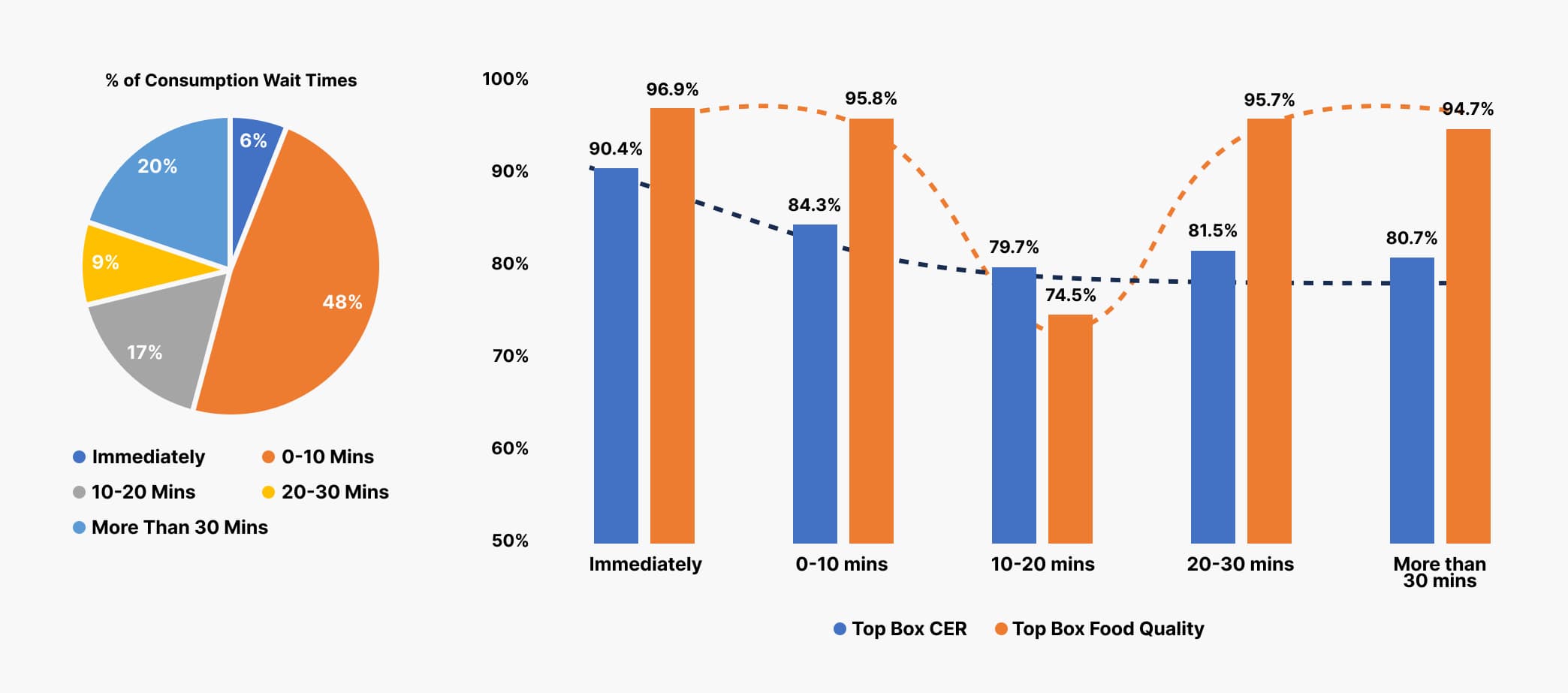
In general, guests consider the product quality and guest experience to be incredibly high within the first 10 minutes. However, there’s a huge dip in perceived food quality for the 10-20 min cohort.
Interestingly, guests that wait longer than 20 minutes will still give the brand credit for product quality, since they have a lower expectation for how warm the donuts would be. However, as time went on the overall satisfaction about the experience didn’t bounce back, but plateaued around 80% (on a 0-100% scale).
Restaurant operations are incredibly challenging. You can do everything right according to the brand standards, but still fail to meet guest expectations.
In this case, every donut location could have fully complied with brand standards: continuous frying to make sure a fresh batch is made every 15 minutes, ensuring a maximum of one-hour hold time, storing donuts in heat-retaining containers…yet guests can still perceive it as a low-quality product if they eat them too late. How frustrating!
This is where you might need to adjust your brand standards to better meet guest expectations. For example, we can try to keep the donuts warm for up to 20 minutes with packaging that better retains heat. Alternatively, we can try to increase the percentage of people who consume the donuts within 10 minutes by adding language on the packaging to remind people to consume the donuts as soon as they can.
This is a great example of how brand standards can be constantly evolving to continue meeting guests where they are. It’s also a great reminder for restaurant executives to keep tabs on guest satisfaction trends, not just each location’s compliance to brand standards.
The same trend of how time to consumption impacts guest satisfaction actually won’t apply in the pizza category. Pizza consumers generally understand that the technology for keeping pizzas warm during delivery (e.g. thermal boxes) exists, and consider it the restaurant’s responsibility to keep the food hot over time.
However, the interesting divergence happens between delivery and pickup. For delivery orders, guests have the pre-conceived notion that pizza brands are expected to keep the food warm regardless of how long it takes. However, for pickup orders there’s more leeway as guests will share the responsibility of keeping the food warm up till the moment of consumption. The opportunity then lies in understanding in general how long your guests wait before consumption (i.e. using the survey method mentioned above), and adopt proper packaging to keep the food warm till that point.
When styrofoam went out of favor in the eyes of consumers due to environmental concerns, coffee chains had to come up with a paper cup replacement that could mirror the performance of styrofoam cups. In addition, given that people consume different sized coffees (e.g. medium, large, XL) at different speed, coffee brands need to map out consumption time for different coffee products and come up with the right packaging that will keep the majority of their customers happy.
Salad brands, on the other hand, need to keep their food cool as long as possible. However, there’s way more leeway for products that are meant to be served cold but slightly warm up, than for products that are meant to be served warm but have completely cooled down. But still, data has shown that there’s a higher likelihood of guests perceiving the product as high quality when a salad is still cold at consumption.
About the Author
Intelligence & Analytics Expert
Alex formerly led Customer Excellence programs at Blaze Pizza and Dunkin'. Now, he oversees LTO testing, operational analysis, and ROI optimization for Tattle partners.